
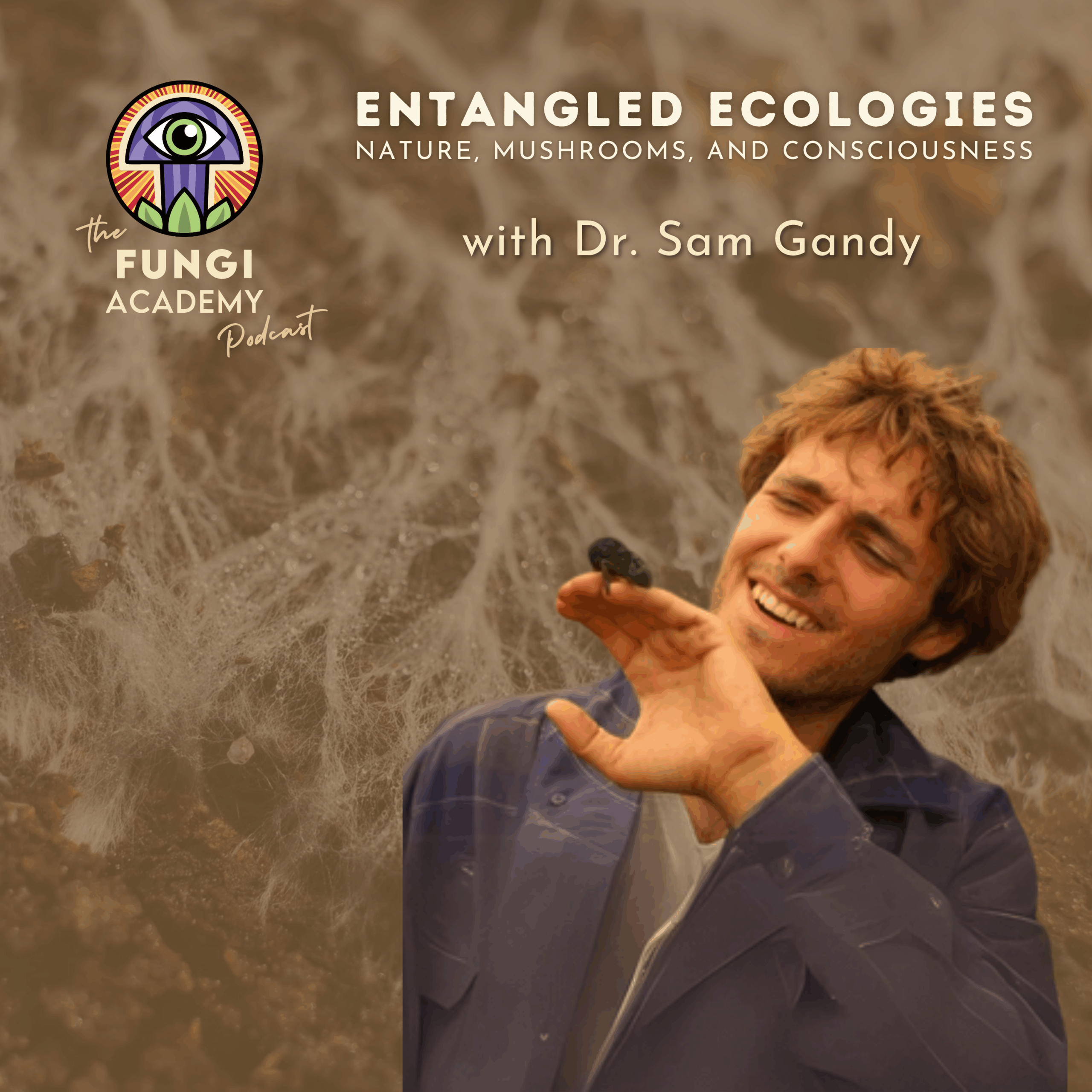
🎙️ Episode 4 – Entangled Ecologies with Dr. Sam Gandy
🎙️Support this Podcast by becoming a Mushroom Member
Ecologist and mushroom cultivator Dr. Sam Gandy dives into the hidden networks that shape life on Earth. From termites farming fungi for millions of years to the microbial multitudes inside our own bodies, this episode explores how nothing truly exists in isolation.
Our conversation moves from cutting‑edge psilocybin research on nature connectedness to the cultural shifts around psychedelic mushrooms, highlighting why these organisms are more than just “psilocybin carriers.” Expect insights on ecology, community, and the profound ways fungi remind us we are part of a greater whole.
🔗 Learn more about Sam’s work:
TRANSCRIPT
Jasper Degenaars (00:02.926)
to another episode of the FungiCat podcast. Today we are joined by Dr. Sam Gandy, who is an amazing ecologist, amazing psychedelic researcher and writer, and also a legend of human being to hang out with. I had the pleasure to hang out with him in person a couple summers ago. And he actually came by here at FungiCat, when I wasn’t here, which is funny, but that’s how it flows. We had a great online.
chat about different species of philosophy mushrooms, cybernetic connection, kind of his youth of expertise. And yeah, I it as much as I do. This podcast is made possible by lovely members of the mushroom membership. You get amazing master classes, get somatic classes, get journal prompts, we have like a monthly research wrap up and lots of other cool stuff. So go check that out. It’s a great way to support
our work and this podcast are happening. Yay. Okay. Without further ado, Dr. Samwise Gandy. We’re just going to kick off with like a big question. What is, what’s ecology? So I would define ecology as it is the science of the interconnectivity and interdependence of living systems.
So if we think of biology as the science of life, ecology is that, but one step removed where you’re not like looking super zoomed in on life. You’re taking a step back and looking at how life is interconnected in various ways and how the energy moves through those living systems essentially. Yeah. And I think that’s important because like, I feel like sometimes science looks at
nature and sees all of these different, maybe somewhat connected beings and living independent lives, but actually, life is only possible in community. Life is only possible when things are working together, when the trees are producing fruits and creating coverage from the sun, and therefore mosses can grow on the forest floor and all that stuff. Like life is this interconnected web. And I think that’s why so many people are so connected or like attracted to fungi because
Jasper Degenaars (02:27.23)
They somewhat archetype this interconnectedness. When were you, when did you, like when were fungi first coming on your radar as an ecology? Was this a big part of your academic program or was this more of a sideline? It’s kind of a little bit of both. So I think so. So firstly, so psychedelic, I mean, I’ve always been interested in nature broadly.
So I’ll say that that’s been a kind of lifelong interest. Psychedelic fungi were, they cropped up at the very start of my undergraduate university career. I started doing zoology in London, Imperial College, and that was a heady window of time where cubensis mushrooms were legal on the high street in London. You could just go and buy fresh mushrooms.
But then also through my kind of academic career, when I came to do my PhD, I looked at termites and their role in water, soil kind of dynamics in Ethiopia. And the sort of the most important termites in that part of the world are the so-called macro termes.
and the Dontotermes as well, but particularly Macrotermes, as the name suggests, are large, they’re the largest termites, but they also build the largest structures, you know, they construct these huge colossal mounds. Some of them are thousands of years old and kind of get re-housed and re-used successively, but those fungi are fungal farmers. They have…
an alliance with Tamittomyces fungi and the termite and the fungus are completely entwined and completely dependent on each other. And those termites form that alliance around 30 million years ago in the Central African rainforest. So those termites have been farming far, far, far longer than we have. Yeah.
Jasper Degenaars (04:49.693)
Do all termites have these obligated relationships with fungi? like I’m always, how do other termites break down lignin and get the cellulose in wood that they perceive to eat? Because the termite, the macro termite is that you’re talking about, kind of like chew up the wood and they vomit it out and then feed it to the fungus, right? They do. Yes. They, they’re actually quite beautiful. They, they chew up.
the woody debris in the plant matter and they can construct this sort three dimensional lattice structure. It looks almost like kind of coral or something. It’s quite an amazing structure. So yeah, some of the termites kind of, use the fungi essentially as like an external gut and then we’ll sort of nibble off little nodules.
of the fungus and that’s how they primarily, I think, get their nitrogen fix and nitrogen is an important part of amino acids and other kind of biochemical building blocks. Other fungi though, it’s only certain sort of families of termites that do farm fungi in that way. think, yeah, the macro-termitone is the kind of larger overarching family, but other groups…
It sort of varies as well with the diet. So some termites are feeding on wood, but others are feeding on more kind of humic debris that’s on its way to becoming soil. And then other termites are soil eaters. So some of these other species, they, rather than having external fungus farms, they have mutualistic protozoans and bacteria fungi inhabiting their guts.
And they digest, break down lignin and things that way. Okay, incredible. And then the certain fun of these termites that kind of already eat decomposed wood is what you’re saying. they still have this relationship with fungi. like that’s something that always intrigues me also in the human experience of like how vital of a role these microorganisms in our guts play. I don’t think like there’s this book.
Jasper Degenaars (07:06.126)
I read it while ago. can’t really quote, but like we are multitudes or something. Yes. author. And I remember like running across it in a, in a like hostile library somewhere in Southeast Asia and just completely blowing me away with like the only fact, I guess I remember is that we have more non-human cells than human cells. like we are also an ecology as, as beings, right? We’re not just like, we think often that we are the individual.
But then like now we’re finding out that a lot of our needs and kind of like desires are actually kind of pushed by certain microorganisms living in our guts that want to eat the sugars. And like that’s that that must go back so long, probably before mammals were even a thing. And we just had insects like dominating the planets that already had this micro fauna live in.
in us. you speak a little bit on that?
Yeah, so no, this is it’s a no, it’s a analogy that you’ve used. It’s like, yeah, we do. We have a slight bias, I think, in Western society to think of ourselves as individuals and existing as individuals in somewhat kind of isolation. And it’s like, and I don’t know how much good that sort of like worldview has done us, actually. But no, we are we’re part of a wider ecology. And we are also an ecosystem unto ourselves in terms of all the
all the multitude of species that kind of make up our guts and you know even our DNA you know we’ve got lots of viral DNA in our human genomes as well so even on the genetic level we’re a bit of a kind of like smorgasbord of different genetics, different organisms. And yeah no I think it’s one of those
Jasper Degenaars (09:06.059)
really interesting frontiers. I see it like as a microcosm of the research now looking at fungi and you know, like for instance, mycorrhizal fungi and basically plant-fungal relationships. That’s like almost like the external big picture view of the kind of gut flora and it’s like we’re, they’re kind of like, yeah, fairly fresh cutting edge areas of knowledge.
that are sort of redefining ecology, both on our singular individual being levels, but then also on the wider lens view as well, Yeah, so it’s like nothing evolved as an individual. I think I heard a podcast with Bruce Dahmer a while back and he had this whole cosmic sludge origin of life theory that
he argued that the first kind of like biochemical reaction that we now call life didn’t originate in a singularity. happened in a community. that’s also like very true. If you look at plants now, we’ve not ever found a plant that doesn’t have fungi living within its cell walls. We look at basically everything and everything. Nothing is an individual. and
Like that’s a different approach, right? And it’s also if we look at our own nature as humans, we are pack animals if we like it or not, and we’re kind of almost conditioned to think otherwise. Yeah. No, it’s true. And we’re sort of re-remembering that, you know, that we’re essentially wired to thrive in a kind of like community.
group and also nature based setting, you know, to be kind of aware and have relationship with other beings, both human and non-human. I think it’s a really important part of our health and well-being. And unfortunately, yeah, to a large degree, that’s been forgotten or is largely lacking, I think, in Western society. we’re pretty, for the most part, many of us disconnected from nature and suffering from isolation and…
Jasper Degenaars (11:25.626)
and loneliness and things like this, even though we might be quite materially comfortable and other immaterial aspects of our being are being forgotten or neglected. And I think that’s afflicting us in a variety of ways. Yeah, and that’s kind of the downside of technology that allows us to live in these cities that have everything.
that we want, like I like this metaphor of like our modern hunting grounds, this supermarket, right, with bright lights and bright colors. And yeah, I think it’s a shame that lifestyle which has given so much people, like I think a material better life than poverty. I think a lot of people that have flowing water coming from tabs are happy. They don’t have to walk like half an hour, an hour to find water.
but that also, you know, it’s when I find that myself in places like that, I have more purpose in life because like, well, it’s like, it’s very clear. have to go get the water or I have to go and, make sure I have firewood for a fire for tonight, because otherwise I, I don’t have lights when the sun is down and that now we have all of these.
options that can be overwhelming and especially with social media that also looks at other people’s lives and the highlights of other people’s lives that’s then we are so overwhelmed and like the connection to nature is is missing and it ties kind of really beautifully into your research of working with the sacred mushrooms or as people like to refer to them in I guess academic circles to the cyban mushrooms and nature connection. So what are some of the most potent things that you have found?
while researching this topic.
Jasper Degenaars (13:18.893)
So, well, yeah, so I’ve actually just heard back from a collaborator who I’ve been working with on our sort of recent paper in collaboration with Imperial on looking at psilocybin and its potential for kindling a sense of connection to nature. And yes, we’re just in the process of submitting this study paper, well, actually two separate studies that are kind of like we brought together.
And it’s been interesting to be a part of that. It’s been a long time coming. It’s taken four and a half years to finally get it to this stage. But essentially people were administered psilocybin, both a healthy psychedelic naive group and a clinical group with a diagnosis of major depression, three quarters of whom had not had psilocybin before. And what was interesting is that we found a pretty
robust increase or enhancement in people’s levels of nature connectedness. But what was interesting to me was that this was like an enduring shift that seemed to stay with people. So particularly our healthy group, we measured people at three months and then six months later. And what was quite sort of compelling was that there was no drop off.
in people’s of nature connectedness increase from the three to six month mark. And that’s kind of exciting because there’s essentially no like research findings demonstrating that nature and connection interventions can foster increases beyond the three month window. I mean, and that’s not because they can’t, it’s just because people haven’t really looked to see if that’s possible. So we’re finding this.
kind of sustained enduring shift that stays with people, which is interesting. But kind of most compelling of all to me anyway, is that people are being administered psilocybin in quite strictly sort of controlled research settings. And essentially there is monitored hospital settings. And you know, the setting like room,
Jasper Degenaars (15:44.96)
or rooms have been sort of kind of manipulated to ensure that they’re at least cozy and comfortable. And they might be a bit of nature-based art or photography, but that’s it, you know, and you’re not really allowed because there’s rules governing these spaces. For instance, one of the rooms was a room designed for immunocompromised patients. So it was like a sterile as you can really get.
and there were strict rules governing about what could be in there. And essentially only the humans were the only like natural entities allowed in that space. So I was fascinated like so much, you know, attention is given to psychedelics acting as non-specific amplifiers, you know, they kind of like magnify, amplify the context in which they are taken and you know, and that’s a good model for how they work.
But what was interesting to me was that, yes, psilocybin when administered, and you know, this is pure synthetic psilocybin. You know, this isn’t the mushroom. This isn’t the mushroom that someone’s gone and plucked from the earth or grown themselves. So there’s already, even before the time of ingestion, some kind of relationship with nature has been cultivated there. You know, whether you’ve cultivated the mushroom yourself,
or whether you’ve gone out somewhere to find it and eat it. This is just people being dosed with pure lab-made psilocybin and being administered it in not particularly, I would say, nature-enriched setting by any means. I would consider it a nature-deprived or lacking setting. And still, we’re getting this robust shift and increase that stays with people. And that’s happening in spite.
of how the psilocybin is being administered rather than because of how it’s being administered. And I find that really compelling. And that makes me sort of wonder, well, you know, what would happen if we intentionally use psilocybin or the mushroom with the prior intention to deliberately deepen or enhance someone’s relationship with nature? know, so incorporating more nature-based elements.
Jasper Degenaars (18:08.245)
content settings, things like that. Like rather than the nature connection thing being this kind of curiosity side act, make it center stage and central focus because I think it’s very much worthy of that. And I hope that once this study paper is hopefully published that it might encourage further work in that direction because yeah, I feel like it’s a bit of a…
travesty to not include more nature-based content in people’s psychedelic sessions. In fact, you know, it’s so important of fundamental importance to our health and wellbeing. I think there’s an ethical case to be made against the issue of not including any nature-based content in people’s psychedelic sessions. Yeah. And it’s funny because it’s like, that’s just a quintessential mushroom experience. You eat some mushrooms, you go to the forest, you go in the fields.
And it’s so funny that like, kind of it’s, it’s lagging, like science is lagging behind because of these strict regulations. And I’ve seen photos and I’ve talked to some of my friends who were in the Imperial College, psychonauts group. and yeah, you’re just basically in a dentist chair and it smells like a dental office and you’re being administered by somebody who’s wearing a bunch of plastic and kind of like that.
like surgeon feel that like I feel uncomfortable if just somebody is already in like such an outfit, just because of these cultural connotation to being sick and being in a hospital. And we haven’t even spoken about the entourage effect of now. forget what university, maybe you can enlighten me, but there was a university that did a control group of people that had synthesized psilocybin.
and people that had hot water extracts, aka mushroom tea, and the group of people with severe depressive disorder that had the full mushroom, they were like, I think they had like a significant point increase even compared to the psilocybin group, right? So that’s why I personally don’t like calling them psilocybin mushrooms because there’s all of these other psychedelic alkaloids and then even perhaps other medicinal compounds that we haven’t even…
Jasper Degenaars (20:29.892)
started to touch at in these mushrooms. And that’s also why I think it’s really important to emphasize what you were saying regarding going out and picking the mushroom or growing it yourself. So you’ve understand the mushroom as an organism, at least a little bit. Like, you understand where it grows. You understand how it grows because you’ve cultivated it. And then that’s kind of a trend I’m seeing in kind of the
the cultural acceptance of psychedelics, especially in North America. And it is also happening in the US. I mean, in Europe, where in North America, the chocolates or the gummies are very popular. then in Europe, especially in the Netherlands, these drops are very popular, which most of them don’t even contain mushrooms at all. And that disconnects us from the mushroom. It’s like, OK, I understand it’s convenient to eat a little sweet chocolate that…
that masks the flavor and experience, then there’s a difference from actually looking at it and maybe even to an extent swallowing the bitter pill, as we say in Dutch, to relate to this organism, to understand like, this is a thing that’s alive that I’m in relationship with. And I think that comes from maybe the first psychedelic experiences, but then, you know, not everybody.
like has that, but you know, I feel it’s, it’s important to, especially for people with perhaps like, depressive disorders to go out and feel other things are alive. feel, you know, it’s almost the typical psychedelic experience that people are in a forest and they suddenly realize that trees are not just static.
objects and buildings, but there are living organisms that somehow make decisions. And we don’t have to even like have psychedelics to have those experiences. Like look at Peter Wolleben’s amazing book, The Hidden Life of Trees. I don’t think he ever did psychedelics. He was just somebody that was in a forest. it shows that like, yeah, we are part of a greater whole and I think more
Jasper Degenaars (22:49.378)
people, especially the people in power need to have these experiences, be it psychedelic or non psychedelic, so they can make decisions that are better for ecosystems and therefore better for us. Yeah. yeah, no, I agree. I mean, you know, it’s quite, it’s not uncommon either, I think for people having these sessions kind of in a kind of more clinical space to sort of express wishes like, I wish I could go out into, into nature now. and yeah, I spoke to someone recently, I’m going to be on
panel with All Things Fungi. And she had some mushrooms in Jamaica as part of a kind of like retreat there, which the experience was very helpful to her personally. But she kind of wished at least on the re-entry point, you know, when you’re starting, you’ve been through the peak and you’re starting to come back, that seems like potentially a good time, you know, when you’re in that phase for people to have the option at least of having more outdoor kind of
or supervised contact with nature. So now I totally resonate with that. And the more holistic view of the mushroom. We know that mushrooms are, they’re chemical alchemists and they are chemically complex organisms just as we are. And so I see what you’re saying. If we overly focus on just calling them psilocybin fungi, like we’re…
Yeah, we’re kind of potentially missing on more like holistic layers of them and their potential kind of entourage effect. mean, this is something that’s interesting to me. So that study you mentioned, I’m aware, like comparing the whole spectrum kind of water extract of the mushroom with psilocybin.
I know there was some research and I think it was using mice as the sort of test subjects, but that also reported comparing pure lab-made psilocybin to full spectrum extract of the mushroom that yeah, the synaptic, the longer term sort of synaptic changes were greater in the full mushroom kind of sample. And yeah, with my…
Jasper Degenaars (25:09.774)
collaborator I’m working with on the Nature Connection research, we’ve sort of tied up a survey study on different species of mushroom, of psychedelic mushroom, because we’re both interested in, know, like, well, whether different mushrooms, at least according to the people who have experience of eating them, like whether people attribute different…
profiles, at least in some respects, to different species. And I know that some researchers will immediately dismiss the possibility, you know, that they’ll say, well, it’s all psilocybin. That’s the only psychoactive ingredient. Any, any other perceived differences in the experience or the effects are down to your set and setting and your expectations about what you think is going to happen. Nothing whatsoever intrinsic to a given mushroom. And I’m like,
you know, maybe that’s the case, but I’m just open to the possibility that it’s a little bit more nuanced and complex than that. And I also think we’ve barely scratched the surface of chemically profiling these fungi. We really don’t know much about what’s in them apart from the psilocybin and psilocin, let alone the possible activity or modulation, modulating effects of these other.
of a compounds. It’s very early days, I think. So we need to be a bit wary about drawing hard and fast conclusions, I think, before we’ve actually done more research. Yeah, I think it’s really important that I’m, years back, I heard of anecdotal, like, small time research of like this, like this place in Jamaica, I don’t think they’re longer around.
finding that mushrooms that are higher in the system, think of Celosavica immanentia, the Liberty caps or Celosavica natalensis, Mexicana, that consuming those mushrooms gives overall for most people more gentle, easy experiences compared to, for example, acubensis, which is kind of the standard and the norm just because of its ease of cultivation and large
Jasper Degenaars (27:32.019)
fruits and also the kind of the heritage cultivation because like we’ve been growing that mushroom for I think coming up to 60 years now. We, that’s actually really low on the assistance. So what most people find when they start experimenting with different species that they’re like, what is it actually more gentle? have less over sensation of overwhelm. I, my thoughts go in less.
negative spirals, which, you know, I think there’s, also something to be said for the challenges in an experience, especially for therapeutic models are, are part of the healing process. But now we are just beyond that as a culture. Like most people don’t take mushrooms or work with mushrooms for therapeutic purposes. And, you know, you can judge what you think, but I think
People have been taking psychedelics at festivals and large gatherings, and I don’t think people are going to stop. So having more understanding to, hopefully in one day where these things are legal and people are more educated in doing these things correctly or safely and safely perhaps. We were talking before the intermission about the different species and different strains of
So I’m pretty curious to your experience on that and what your opinion is as a cultivator, as somebody that’s worked closely. Do you have favorites? What is your take on the debate regarding different varieties of cubenses? Yeah, well, so yeah, I’m happy to chime in here.
it’s a topic that interests me. So firstly, regarding cubensis, cubensis mushrooms, obviously you know they’re fantastic, like they’ve sort of allied themselves to humanity, very easily domesticated mushroom, grow very easily and bountifully and yeah and I feel like, yeah there’s, whether
Jasper Degenaars (29:55.3)
I know some growers, some cultivators and silo-naughts, swear blind that different strains or varieties of cubensis, of which there’s many, vary consistently. And then other folk point out, well, you know, if you take the same dose of the same flush of the same strain, you’re gonna have quite a different experience.
each and every time and that you know that is something to bear in mind like the amount of factors that go into shaping or sculpting a mushroom experience are many and no two experiences are ever going to be alike. That being said it doesn’t necessarily mean that there aren’t certain qualities of effect that might not be sort of consistent or there might not be
that there might not be trends and effects that crop up fairly reliably, if not all the time. I remain, I’m not sure about, although I know that penis envy cubensis are known, they can definitely be a bit stronger and there’s certain like mutants of cubensis like enigma and stuff that can be fiendishly potent. mean, highly variable, but capable of being very potent. And some people,
have a kind of special reverence for those strains. But personally, in my experience, both when it comes to research and personal experience, things get more interesting when we start considering other species rather than varieties of strains of the same species. And I guess, yeah, part of what motivated me to want to do the research.
study I mentioned with my collaborator is it was reading, so I’m sure you’re well aware of, yes, Psilocybinatalensis or what was referred to as Psilocybinatalensis has now been provisionally renamed as Psilocybinocracia centrata. So much harder. Why? I understand it’s correct, but can we just, why does it have to be such a difficult name?
Jasper Degenaars (32:16.149)
That’s just like keep calling it Nathalensis. Nathalensis generally is not a real species. that’s changed. It’s more like everybody knows the name. Yeah. Well, it’s tricky because Nathalensis is still its own species. It’s still very much his own species, but they had to kind of split apart these two species that were being lumped together. yeah, so Okra, we’ll call it Okra for short.
It has kind of, it’s very much made inroads into the cultivator community. And we know from genetic studies that it’s the closest living relative to cubensis, to psilocybe cubensis growing in Africa, Southern Africa. And they kind of diverged from each other about one and a half million years ago. So, but what’s fascinating to me was, and this is before, know, cause I guess sort of skeptics would go, well, you know,
there’s a lot of expectancy at play here, because people are reading other people’s testimonials and accounts, and then they’re going into an experience, know, primed, essentially. And yes, that can and does happen, but early experiences, there was very little, there was very little accounts available for people to even read. So they were kind of going in largely blind. And what fascinated me and made me want to kind of look at this was like,
the level of consistency in people’s accounts. And that’s factoring in the wide variation in the individuals eating those mushrooms, the wide variation in set and setting that people are probably consuming those mushrooms in. But essentially people kept saying the same kind of thing again and again and again and again. And that was things like perhaps the most common one.
I would say for the okra in particular was when people, know, people obviously very much have, tend to be experienced with cubensis. That’s like the standard mushroom species that most people, pretty much everyone who’s into these fungi will be experienced with and acquainted with. So that tends to be the comparative benchmark, if that makes sense. And people would compare
Jasper Degenaars (34:41.524)
having ingested and have this kind of the experience with the okra mushrooms. And they’ll say, just, had less body, body load, body noise. Like there was less, there was less gut trouble that had maybe less bloating or less gas or less discomfort. And, and I just want to like zoom in on that one thing alone, because that’s, I would say at least from the accounts that I’ve read, that’s the most commonly reported difference that’s made when people compare the two species.
I attest to that and also like personal experience. And then I have a friend who supplies festivals and he actually loved okras so much that like he changed all of his chocolate formula to okras. But he had to stop because people were like, I’m not, these mushrooms? Because like they associate the body loads, almost the uncomfortability with the experience.
Yeah, no, it’s fascinating the range of reactions. So some people can, some people can’t notice any different. They don’t notice any difference. They’re like, it just feels like cubenses to me. I’ve had experiences where it just felt like cubenses. And then I’ve had experiences that felt wildly different. But then you’ll get some people who can’t even believe they’re even having a mushroom. It feels like such a different experience. It’s like they’ve ingested a whole different drug. So you get this.
huge range in reactions. But yeah, the lack of the smoothness on the body, at least for some people, as you say, some people might come to expect that as being part of the mushroom’s effect. But some people really struggle with the body loads, with the physical elements. And it varies, I think. There’s individual sensitivities. Who knows, it might be related to gut flora stuff that’s going on.
I’ve noticed as well that those side effects, those kind of body load, body issues, side effects, don’t tend to get better as you get older. And for some people, it can become a barrier to actually ingesting mushrooms. So the fact that you’re able to maybe have an alternative species that doesn’t seem to of flare up your body in the same way can be quite appealing to some people.
Jasper Degenaars (37:05.561)
you know, other chemistry has been found in the okra mushrooms as well. There’s antioxidant, anti-inflammatory compounds in there. So some people, again, this is pretty anecdotal, but some people kind of revere them for those qualities as well and prefer them for that reason. Yeah, so I don’t know. that’s what’s interesting to me is like people kind of compare these species so frequently.
and yet it’s the closest relative to Psilocybe cubensis. So what about when you start considering more distinctly related species like Paniolus mushrooms or other members of the Psilocybe genus? You know, for instance, the species held in high shamanic reverence in Mexico, you know, the Mazotec, Zapotec, those people who’ve been using these mushrooms for centuries, they know a thing or two.
And they also take the view that different species vary in qualities or character and certain species are favored or revered over others. So, yeah, mean, I’m totally, there’s no doubt that the setting setting factors and the expectation, all those effects are the primary most powerful sculptors or molders of the psychedelic experience. There’s no denying.
It would be foolish, I think, to sort of try and refute that. But still, I don’t know, at least in my experience and the experience of many others, it seems like there’s a little bit more nuanced complexity going on when it comes to these different species. mean, in my experience, like Paneolus cyanocens mushroom experience, it’s a different order.
to the Cubensis experiences I’ve, and I’m not saying that to denigrate the Cubensis, it’s just a different type of experience. And then as your essence, philosophy as your essence is again, it’s its own thing. So yeah, I think that the more species I’ve tried, the more open-minded I’ve become to this view. It’s not made me more skeptical.
Jasper Degenaars (39:30.486)
sampling these different species, it’s made me more inclined to be open-minded to the possibility that there is some kind of subtle difference going on here. And just to finish on that, because certain people will dismiss this entirely as expectancy effects coming into play, but what’s interesting is that while expectancy effects are powerful,
They are not all powerful. So what you see in some accounts is you’ll get people trying, for instance, Paniolus sanissans mushrooms or the okra mushrooms, and they’ve read these accounts and they’re like, goody, this is gonna be a nice mushroom experience. It’s not gonna give me body load. And they’ll have the mushrooms and they’ll maybe try them a few different times and be like, no, I don’t like them. They don’t vibe with me. They make me feel anxious.
You know, they’ll have certain issues and that’s in spite of them having been primed to have a good experience with what they’ve read. So, you know, that needs to be, I think, sort of factored in as well. Yeah, for sure. And like what I think is interesting is that this is even a debate with mushrooms. Well, I don’t think there’s anybody out there that says that Peote and San Pedro are the same. Like, yeah, right. And like, yeah, it’s like.
So we accept that, it’s harder for us. And I think this is because we are so focused on this one compound. We’re not talking about masculine cacti. We’re talking about peote, warchuma, San Pedro. But we are talking about psittocybin as like a blanket statement. I think that has unfortunately pushed it so that everything is kind of similar. All the Martians are similar. And I love that you…
Yeah, like reference the Zapotecs and the Mesotecs because they did have different names for these mushrooms. And sometimes I see people teaching indigenous ways or like the Mesoamerican psychedelic experience and they’d use pictures of psilocybin gubensis and then they call them Teotlana-Nacatl. Well, there’s some evidence from the Guzman family that certain of these nations, these peoples, they
Jasper Degenaars (41:55.124)
referred to the psilocybe cabensis as the white man mushroom because it was very unlikely that it was present here in the Americas before the Spanish came with their cattle and their horses. they have different applications in these traditions. There’s divination rituals that are
probably were more like kairi lessons and zapate korum, while the healing rituals that Maria Sabina was known for was more likely philosophy Mexicana in general. that was her favourite, that was apparently her favourite species. Because much attention is given to Albert Hoffman, obviously, as I’m sure you well know, sort of like
went out to Mexico, having received the mushroom samples in his lab at Sandoz in Switzerland. He went out having figured out isolated synthesized psilocybin and he made it into pure pills. And then they went out to visit Maria Sabina. Allegedly, allegedly. Was this recorded? Because I couldn’t find like a full 100 % source. But obviously this is what you hear that she then had the psilocybin.
synthesized and she’s like, this is exactly the same as the mushrooms. But then other accounts told, tell that after she gave Gordon was in the mushrooms that she the mushrooms start talking to her periods. So it’s like, how much is truth and how much is legend at this point, it’s really hard to know. And you know, there could be other factors in the mix. I who knows, she might have just been wanting to be polite, you know, getting the sense that these people have come a very long way and like she wasn’t going to go, no, this is rubbish.
But like, I mean, at least from, you know, some of the studies at least that are being done with pure psilocybin, you know, suggests that it does have, it does have, you know, is effective. It does have power, maybe not to the same degree as the full mushroom, but it’s not lacking in mojo, we could say. while much attention is given to that, less attention is given to the fact that Maria Sabina did not use cubensis mushrooms.
Jasper Degenaars (44:11.416)
in her velodas. She did not like them. Whereas Mexicana were apparently her favorite. Yeah, so different shamans among the Mazatec and other groups would have their own preferences for the mushrooms that they would work with. Yeah, and like, although it wasn’t exclusively Mexicana, because there’s also this documentary from the 80s, I think, or 70s that had her in it. And she was holding different philosophy mushrooms that
don’t look like Mexicana to me. So I was like, she definitely was working with others, but like also you’re talking about the mountains of Oaxaca where you have, I don’t know, easy findable 15 ish different species of philosophy that might want to encounter, especially if you’re looking, probably a lot more. like, of course these peoples that were more, and this is when we get back into nature connection, right? Where these peoples were more connected to their environment because they needed
to be. This is also why there’s still mycophelic cultures in northeastern Europe because until recently, like winters were still so brutal and like infrastructure networks weren’t as established over there. So yeah, if you wanted to have foods, like lots of food during winter, you better like spend your fall foraging, drying, fermenting mushrooms. And that’s a connection to nature that’s
we in the global north or west, whatever you want to call it, we don’t have anymore because we have supermarkets. that’s, I think, very profound. And I think that’s why a lot of people get so much fulfillment out of forging mushrooms in the wild, because it connects us to this ancient part of ourselves that’s kind of lost. Like, I can provide by walking through a forest and finding these mushrooms and then eating them.
with my friends. And that’s so hard because I spend like two hours going in the hills here in Guatemala and I find mushrooms for maybe like myself for like two days or three days. So it’s like incredibly hard to get mushrooms out of like enough nutrients out of nature. But I do think it’s very profound and fulfilling. Yeah. Now I agree. it’s sort of like…
Jasper Degenaars (46:34.583)
You know, as you say, it’s not just the destination in terms of securing yourself some good food. It’s the whole journey and the process of actively getting out and looking and getting your eye in and getting out into nature as well. That’s enriching and nourishing in its own way before you even find what you’re looking for. Yeah. And like getting to know these organisms too, that you see a mushroom you’ve never seen before and you try to figure out if it’s edible or psychedelic or medicinal or any other way. like that’s…
that I think with tools like iNaturalist and all these apps that you can take pictures and you get a pretty, the mushrooms are a little harsh, but like you get a pretty good sense of what genus you at least encountered. And then that’s why iNaturalist is very good because then you have human feedback that can tell you if it’s what species it might be. so I think for us to be more connected to nature, we’d be living also kind of in a golden age because of
technology and I think that’s the whole conundrum is like technology has all the capabilities of making our lives easier and make like help us be more connected to nature without having nature teachers. But then it’s often doing the opposite because it’s also distractable and it’s disconnecting us. What are some ways that you that you like utilize technology, but also for you to connect with nature that does don’t necessarily have to do with.
psychedelics, because I think we’ve broadly covered like how crucial that can be. But I think there’s also many other ways that we can connect to nature. Yeah, so I mean, so it really starts actively connecting to nature. And I guess it’s yeah, it’s good to just sort of maybe define or redefine what that actually is, because there’s having contact with nature. And then there’s actively connecting with nature and they are
related but also distinct. Like you can have contact with nature but in a quite detached, superficial, passive way that’s not really cultivating connection. Connection is a kind of active, engaged process. You can’t really half-ass it. You’re either all in or not. You know, it’s the subtle difference between hearing Birdsong and actively listening.
Jasper Degenaars (49:03.325)
to birdsong. And so the foundation of connecting to nature is really based or built on your attention and where you choose to put it. And that’s obviously kind of a bit easier said than done because technology is very good at sort of siphoning that attention off and we have to be aware of that. So yeah, it’s getting out into nature and not being on, you know, not
being on your smartphone, it’s fine to take photos actually using tech, using a camera, using a phone. Nature-based photography is a viable means of connecting to nature because you have to take good photos, you’ve got to be observing your environment and engaging with it. So yes, so tech can be compatible with actively connecting to nature. So by all means, yeah, nature-based photography is great.
But one quite simple practice, which is accessible to everybody, deceptively simple but quite powerful, is to journal about what you encounter. So this has been scientifically tested in a number of studies. And the original kind of practice is called the three good things in nature.
practice and it would essentially centre on anything that you encounter in nature, in your day-to-day life, anything that evoked some kind of emotional reaction. So wonder or awe, fascination, joy, intrigue, anything like that. You just very simply like would record a single little short note or a sentence.
relaying what that experience was and what it meant to you. And it sounds like almost a little bit sort of trivial, but the original study that looked at this, what was interesting is they had a control group that did the same thing, but instead recorded facts about nature. So a more kind of objective, intellectual, detached, scientific kind of lens onto nature, rather than something much more tied to
Jasper Degenaars (51:23.012)
emotion and direct experience. And the control group who recorded facts, there was no change in their relationship with nature, which like hints that that kind of emotional experiential aspect is quite key. But there’s something powerful. You know, there’s been research on journaling more broadly. It’s been used as like a supplementary spiritual practice. It’s been used as a kind of therapeutic practice. People
conduct gratitude journaling, that’s been shown to be a powerful means of bolstering mental health and wellbeing. So journaling is a surprisingly or can be a surprisingly potent practice for the amount of actual time it takes, it’s literally a few minutes. But there’s something powerful about rendering a thought or something that’s in your kind perceptual awareness, taking the time to simply commit it to writing.
you’re engaging, you’re kind of helping solidify something in your mind and you’re engaging more of your total mind by rendering something into word form that hasn’t existed in that form before. So that’s a really quick, easy and tried and tested practice that I think is accessible to anyone that yeah, that I’d recommend trying should you so desire to.
Hmm. So to kind of like, break that down a little bit. the, invitation is to go out and go for a walk in nature, try to be as present and observant as possible and then sit down preferably on a rock or something, some nice moss and don’t, don’t damage the moss. The moss is like so hard because I know I’m damaging it, but it’s so invitational because it’s so soft. Anyway, somewhere, somewhere nice.
And kind of not over think it, but more describe what this nature is making, like this experience is making you feel. that like kind of what you’re? Yeah, that’s essentially it. mean, you know, we’re obviously we’re very visual creatures, humans, you know, all any and all of your senses are telling you. So, you know, what can you what can you hear? What’s going on in terms of like there might be bird songs?
Jasper Degenaars (53:49.677)
might be insects, there might be frogs, depending on where you are. And then there’s that obviously the smells of nature, there’s the flowers, there’s a smell of like, like moss and damp, damp leaves and mycelium in the the woodland, the smell of soil, like, yeah, so tune, tuning into what’s going on with all your senses. Not just what you can see with all your senses. And the more that you do that,
the more you will be rewarded for doing that, the more interesting or inspiring things you will encounter in your day-to-day life navigating the natural world. And you know, if you want to, mean, there are other options here. So that’s one sort of like…
fairly accessible approach is getting out and about and just keeping your senses open. And then if you so desire, making a simple little very brief recording of anything that kind of moves you in some way. But there are other, as mentioned, nature-based photography is very much a kind of like pathway to cultivating that connection. Undertaking nature.
restoration or like say for instance planting wild flowers and having those in your vicinity and obviously the flowers themselves but all the insect life, the bees and the butterflies and all the pollinating insects that can create. So sculpting an environment in your vicinity if it’s your garden or your surroundings to enrich it for other forms of life. That is a never means of
bolstering your connection to nature because yeah as mentioned like one of the researchers one of the senior researchers he calls it simply noticing nature as being the core foundational aspect of nature connectedness which sounds so simple and it is but actually getting some people to take that first step to actively notice is that’s the challenging thing
Jasper Degenaars (56:09.919)
And that’s where, interestingly, we’re talking about tech. One of the studies used a smartphone app to nudge people to get them to notice nature. And they were in an urban environment. so maybe we think there’s less nature, and there is to a fair degree, but there’s still nature there.
to be found and observed. There’s still like parks and there’s still sort of wildlife very much inhabits our towns and cities. You just need to be kind of aware of that. So some people need a bit of a nudge towards noticing, but the more we start noticing nature, it’s kind of like a positive feedback loop. The more things we will then notice and the more things we are likely to then to want to notice, I think. Yeah, and I think that’s why mushrooms can be so powerful because
Unlike trees and plants that are kind of background, always there. I think we’re also very visual, but also very prone to find something that wasn’t there before. Maybe it was a hunting nature, maybe it was a fruits finding nature. So we’re looking for irregularity in nature as well, because that’s how generally we found foods and potential predators and so forth.
I think that’s why for a lot of people mushrooms are such a great gateway of finding or noticing nature. Because maybe you’re cycling through Westerpark in Amsterdam and suddenly you find a Ganaderma apanadam that you hadn’t seen before and then it catches your attention because it wasn’t there before and now it’s there and it maybe has applications.
I think it’s a great gateway. I’ve definitely started noticing nature more myself after getting into mushroom foraging. then my friend likes to say it’s like ABF, always be foraging. So it’s like rainy season, you’re in the side of a car and you’re like, my God, I saw something growing over there. I think those can be great practices.
Jasper Degenaars (58:25.597)
With that comes also like, okay, you’re looking for certain mushroom species. Okay. So you start figuring out what tree they grow under and then you’re starting to recognize the trees and you’re out of nature a lot and you hear bird songs. And there’s also like a cool app that I was shown recently, the Merlin app, and you can like, record and you’re walking through the forest and then the app will tell you all the birds you’ve heard. And then you can play back what you’ve heard.
And then you can start identifying as like, that’s a red Robin. That’s, that’s a nightingale. That’s this. And, because that used to be passed down, by teachers and like so much of our education is unfocused on nature. And I think that’s, that’s crucial as well. That like our education, our schooling systems need to like also pass this down. And maybe that’s giving too much attention to schooling systems, but like, yeah, you can’t expect.
a nuclear family like parents to be able to do everything. I think education happens in communities as well. And then it’s exciting. There’s a group of younger kids here and like, when they’re out in the forest, they’re always like, okay, they’re only interested in mushrooms because we are interested in mushrooms. then they’re asking, what’s this one? What’s this one? like,
I think that’s a crucial aspect, right? So it’s like, think a lot of these studies are also focused on doing this by yourself, but perhaps like going out with a friend and going, doing this noticing nature and then separately writing this stuff down and then talking about it to fully integrate. I think is another way to approach that. You said you had other modalities as well to connect more or notice nature more. What is some other things that you practice?
So yeah, so we’ve got, so well, yeah, for some people, for the artistically inclined, yeah, art, artistic practice, nature-based art, you know, again, it’s tapping into, you know, the whole kind of right brain or the more sort of experiential, emotional side of you. It’s sort of like, it’s pushing you out of your normal, the kind of more rational, detached.
Jasper Degenaars (01:00:47.337)
aspect to you, which isn’t really particularly primary when it comes to cultivating nature connectedness. So that’s a never potential pathway. And I like what you had to say about foraging as well. And that’s of tuning you in, particularly the ever changing cycle of the seasons as well, and sort of like keeping an eye for what’s changing and what things are appearing.
I think that’s good, tapping you into the flux of the seasons, these latitudes anyway. And just to kind of add as well, obviously meditation is pretty big right now, mindfulness meditation, and these are all like, see, a useful kind of modality. But I think some people really quite struggle with just like sitting down and observing their breath and watching the thoughts kind of.
go past and stuff. Some people take to it very well, others really struggle with that, with the discipline or the motivation needed to keep that up despite the potential benefits. The thing that I quite like about nature or being in nature is that rather than say using your breath or a mantra for an anchor for your awareness, just being in nature and the sensory input kind of naturally plugs you
into kind of a present moment state. You don’t need to sort of cultivate it, so to speak. You just need to sort of like flow with it as it happens. And yeah, walking out in nature in the woods, you’re kind of plugged in effortlessly into that present moment, into a kind of state of mindfulness, if you will. And we know from the research literature that mindfulness and nature connection are deeply interwoven. mean, nature connections.
a fair bit more complex than mindfulness alone, but mindfulness is definitely a predictor. Like the more mindful you are, particularly in nature, the more sort of connection is likely to be cultivated from there. I mean, and there’s other options as well. mean, there’s been some recent research looking at, you know, in some areas you can meet up and do like citizen science, nature-based project work.
Jasper Degenaars (01:03:10.933)
you can link up with volunteers and work on sort of sculpting or doing habitat management, habitat restoration in public areas managed for wildlife, nature reserves, maybe like river cleanups, activities like that. And what you’ve said about having, sharing these experiences with a friend and then sort of reflecting and
talking about it and that can help integrate these experiences and like I really like that and that’s what I think is quite powerful. I wrote a paper in collaboration with some NHS public health officials and psychiatrists here in the UK and essentially making the case for group-based nature-based restoration activities. So
yeah, the possibility of getting people in groups out into nature and doing like habitat restoration and creation, tree planting, whatever it might be. Something that kind of is hands-on gets you physically engaged with the environment. So you’re in nature, you’re getting exercise, you’re with a group. So even if you’re perhaps not the most nature, the most earthy,
or nature-leaning individual, you’ve got that social element of being with other people. And we also know, although we’re like, I would consider like, we’re a deeply disconnected society, like Western civilization, you know, unfortunately, our societal value system is disconnected, to put it simply, you know, we have a very individualistic, materialistic
anthropocentric society and all those values baked into our societal kind of value structure unfortunately sow seeds of disconnect. So that’s a bit sort of sad but what’s hopeful and positive is that there are many pathways back to deeper connection and we know for instance that social connectedness
Jasper Degenaars (01:05:29.798)
connectedness to other people, to your friends, to your family, as well as that being a really important buffer for mental health against depression, we know that social connectedness and nature connectedness, although they seem quite different, they’re really not actually that different. They’re just different expressions of the same construct in a sense. And if you cultivate one of them, you tend to also cultivate the other as well. So, and I feel like they…
they synergize. So being able to do hands-on nature-connective activities in nature, in groups, could be a really good positive big bang for your buck thing. Like for instance, we know from the research literature that the more nature-connected you are, particularly at higher levels of nature-connectedness, it shifts from being like, I appreciate nature. I…
I appreciate being part of nature. I’m aware of being part of nature. It moves from that sort of awareness to like, I want to do something on behalf of nature. There’s like a, there’s a certain level where there’s like, it kind of kicks in, in terms of like motivating people to actually alter their behavior and in how they interact with nature beyond just appreciating it or being aware of their connection to it.
So we know that from the research literature, but I think it goes two ways. So if you’re actively engaged with nature and rolling up your sleeves and doing something in some way to restore or help it, I think that is like a direct is a more direct hotline to cultivating a deeper connection to nature as well. Yeah, like the word that kept coming up.
in your share was belonging, right? Be it personal connection, be it’s nature connection, which is like, sometimes I feel like, do we have to connect to nature if we are in nature, but that’s because of our society and our culture. And like, if we feel that we belong to something bigger than us, right? We belong to a tribe. think that’s why cults and all of these institutions that we’ve established that like,
Jasper Degenaars (01:07:46.137)
that make us belong to something are so enticing for lots of people that are looking to belong. And I think if you are like deeply understanding or deeply grokking that you are part of nature, that gives such an immense amount of belonging. And I feel that’s what we’re looking for in the Western society so much. It’s like, why do we belong to these nation states?
Most of us are more more starting to disagree with the actions that these nation states have taken. So do we belong to a political party? Do we belong to a generation or subculture? like, you know, this sense of belonging can be cultivated by going out in nature with your friends. to weave back the psychedelic experience in that, I do also think that we have to get out of this, no, like psychedelic has to be done in this controlled…
like room way. I do think that’s taking psychedelics in nature with your friends can like, like we’re talking about big bang for your buck. it can be incredibly fun and powerful as long as it like, it can also be dangerous, of course, especially if you’re in really remote, wild places, but this is where education comes in and you’re not going to go do an incapacitating those. even like I’ve seen models where there’s a bunch of people,
like on beds outside when it’s nice in the dark and kind of have that internal experience that we are more familiar with in the current model at least, but then outside. you like wake up or you get out of your teepee or whatever. You’re like, well, what does nature right there? And there’s other people having this experience. then like, there’s a lot of emphasis on integration, which I think is incredibly important. And there was a friend who was working with an indigenous tribe from the Amazon lots.
when he confronted some of these spiritual leaders about integration, he’s like, well, what about integration to go plant a tree? And that was their response, right? So like combining these two things perhaps of like having these much, these ceremonies, these experiences in nature, and then with that same group going to supports, like doing something in name of nature, like you were saying, like planting trees together the day after, wow, I feel like you’re…
Jasper Degenaars (01:10:12.779)
and then obviously journaling about it and all these things. think with that we have all of these pieces in the literature and the understanding and the science and now it’s just time to kind of start stitching those together perhaps. Yeah, yeah, no, I totally hear what you’re saying and you know, I’ve tried to kind of, I guess, advocate for this in my own work.
I really think there’s a lot of potential here, kind of weaving in nature-based settings or eco-therapy with psychedelics. There’s a lot of funky cross-pollination potential that’s not really being much explored. There’s a few little isolated pockets. I’m aware of an ayahuasca retreat, I think in Costa Rica, that sort of couples the ayahuasca retreat scenario with…
deep nature immersion and also nature restoration activities on the site. So there’s like, there’s a few people sort of thinking about this and giving it attention. And you know, you’re right as well. Like I did a really interesting, it’s part of an interesting study paper with a few colleagues called Transpersonal Ecodelia. And that was really fun because rather than just showing or demonstrating that
that there’s an association between psychedelic use and nature connectedness, that study asked how and why are these changes happening? So that was really interesting because it was a qualitative study and we were asking people with psychedelic experience how are psychedelics affecting your relationship, your connection with nature. And that was cool because not only did we…
Did it shed light on some of the underlying mechanisms? Like some of them, perhaps not that sort of surprising, like the psychedelics evoking like a sense of unity and interconnectedness with nature while under the psychedelic, particularly obviously more likely if you’re already in nature to begin with. That was by far the most commonly reported theme. But then some other interesting things like transmogrification was quite common. that’s… Can clarify that term?
Jasper Degenaars (01:12:33.536)
Transmogrification. Transmogrification, yeah, it’s a good word, isn’t it? It’s a fun word. It’s essentially mental shape-shifting. is, during the psychedelic experience, shifting to take on the form of a never species. And it’s something that crops up a lot with shamanism, know, like without any psychedelics even being involved, like shamanic drum journeying, themes of shape-shifting.
into other species is quite a common transcultural shamanic experience. And that was a way of like widening people’s lens when it came to kind of like looking at nature and sort of seemingly to be able to step into the shoes, if you will, of a never form of life in their experiences. But what was also interesting is the study also probed
people’s relationships with nature and their use of nature based settings. And some people, for instance, preferentially would seek out nature to have psychedelic experiences in. Other people would go out into nature to self soothe if they were having a challenging time. And it was, and it also seemed that people having these experiences in nature, it was also on occasion
kindling these feelings of stewardship towards nature and feelings of care towards nature. So there was some, yeah, there was some interesting sort of like positive things that sort of, yeah, that came out of that. And I’d like to see more work done. I’ve heard interestingly a guy gave a talk, he does like nature wilderness, nature immersion retreats. And I was thinking like, like you were saying with the TP and the beds outside,
You could definitely like the thing about the clinical setting, one of the things it’s got really going for it, and yeah, it’s got a few things going for it, arguably, but one of the things it’s got going for it is that it creates this security blanket where it keeps things contained and safe for the person having that experience. And nature, even somewhere like the UK, where it’s been very manicured and depleted and sculpted.
Jasper Degenaars (01:14:57.684)
nature is inherently unpredictable. know, the weather can change. Wildlife can get up in your grill. You might be assailed by mosquitoes or midges. You might encounter random humans that you don’t particularly want to bump into in a vulnerable state of mind. None of these things, I would say, are insurmountable issues. It just requires a bit of thought and planning ahead. And I really like the idea, like you’re saying with the teepee, you could have
some secure, safe, indoor structural space, you know, and then, but you’ve also got the option of the outdoors and nature. what piqued my interest was this particular nature immersion sort of retreat holder said, it takes about three days of being in deep nature for your mind to sort of settle down after, you know, compared to the mode it’s normally operating in.
in normal Western life. And I was thinking, imagine, yeah, sort of allowing that half week for your mind to sort of settle and your equilibrium to shift and sort of take in resonance with the surrounding nature and then have a mushroom experience. And then hopefully have more time out in nature after that as part of the integration. That could be pretty cool.
There’s a lot of rich potential here, I think. Yeah, I think so too. And I like what you described is ideal. I think we have to… I heard of so many retreats where you arrive and you literally like just spend 12 hours flying and going through some of the most intense experiences and then you sit down, you have a little welcoming circle and then three hours later you’re drinking the ayahuasca or you’re like you’re taking the mushrooms. And I don’t think that’s very conducive. And it’s kind of, again, like…
within this model of like, okay, people have only a weekend off or especially like catering towards people from the United States where there’s so much, so little, so limited pay time off for these people. they’re trying to cram it, cram it in real quick. And I don’t think that’s conducive. I think time is more conducive. And I also like want to emphasize that like none of these things need like to be connected to nature. You don’t need to have psychedelics. Sometimes I think in
Jasper Degenaars (01:17:20.897)
the psychedelic circles, they’re so often like, if we just give Donald Trump psychedelics, he’s going to love nature. Like, probably not. And like, I don’t think they necessarily make better people. Right. And I think just to emphasize, like to put the words back in, like the focus back on people like Peter Wolleben, who wrote, I think one of the most profound books on being connected to trees and just being out there. Right. And like making time.
Because we all choose where we spend our time. Make time to be out in nature and have that connection. I think a lot more will come from that. And if you can make time for three days in deep nature and then have a mushroom experience where you feel more connected to nature or you feel called to help people be more connected to nature, that could definitely be a way.
What’s the way that we can do this when people live in urban environments? Because I think it’s, you know, like it’s, well, you know, you’ve been here at Funky Academy, you know, it’s like how lush is it is for me. It’s very simple. I’m like looking at like a monstera that’s bigger than me. And I’m looking at like a tree covered in lichens with some form of like air plants flowering from it.
It’s very easy here for me. And I know where you, I’ve been to your house in the UK as well. And it’s very easy to be connected to nature there just because of the, I’d say almost the privilege of just being able to choose where we live. But a lot of people live in urban environments and like it’s so much harder to be connected to nature. What have you done when you lived in urban environments to feel that connection?
Yeah, no, no, it’s a good question. And it’s a valid point. And it particularly applies to the UK. Like one of the issues we have here when it comes to accessing nature is there’s a huge kind of economic disparity, where people of lower kind of income groups tend to be in parts inhabiting parts of cities that have less green space or opportunities for connecting with nature.
Jasper Degenaars (01:19:36.4)
And it’s a real shame because we know that these natural settings can function as what has been termed equigenic environments where they so usually lower socioeconomic status usually translates to lower health status. But what’s interesting about having access to natural settings is it can block that. It can it can block that sort of transference like it’s not
amending the underlying inequality that’s giving rise to it, but it can act as an effective block or buffer. But unfortunately, people who are on particular need of having access to nature tend to have sort of less opportunities. But I mean, so I’ve done yet various different stints living in Aberdeen and London and Leicester.
and yeah a few sort of big cities over the years and there’s you I mean maybe again I’ve been sort of quite lucky there in the in those various cities that I’ve lived there’s usually been a park somewhere not too far away from me so I can I can access some greenery and trees without going too far and
And I’ve been quite impressed actually with the quality, at least in London, some of the parks, mean, in Europe, for instance, like Berlin, the quality of the parks there far exceed anything we’ve got going on in London. The parks are full of nightingales and all kinds of wildlife that we don’t really see to the same degree in London. But that being said, there is wildlife to be found there. And I’ve been quite impressed with some of my visits to…
to London parks, because we tend to think countryside equals nature. And unfortunately, depressingly, sometimes the countryside can be thoroughly depleted because it’s being so intensively farmed, the countryside can be a bit of a desert for nature. Whereas some of the parks and stuff in some of the cities can be little pockets of richness. So I feel like…
Jasper Degenaars (01:21:56.859)
Yeah, if you can access it, there are some nice pockets in quite a few of the cities to be found. Like I was in Mexico City last year visiting Sasha, our mutual friend Sasha, and I was impressed with how green the city was for one of the most popular cities in the world. It was cool to wake up to the sound of birdsong and see like hummingbirds and butterflies and like…
have nice sort of tree line paths all go weaving through the city, at least the bits that I kind of was in. Yeah, I was about to say Mexico city is very diverse and the gentrified touristy zones are very different than I’ve spent some time couch surfing in Mexico city. And there was places where like you just in the concrete jungle and you have to like, you can’t walk on the street at night because it’s too dangerous still. So it’s like,
Mexico city is a weird, weird place for that, but I do agree like Roma Norte and I don’t know, didn’t know where you were staying, but I stay, I stay often in Roma Norte when I’m there. it’s like, wow, the parks are incredible. It’s, it’s very, yeah. And like, speak from a biased position as a European, but European because it’s walkable. It’s like nature. And I think that’s a big part of it too. I’m a big advocate for, redesigning and more walkable cities.
because I’ve had the luxury of living in the Netherlands and seeing what even urban life can be and just having trees and like being able to walk and seeing the sky. That’s like because so many people live lives where they like get out of their apartment and get in a car and they’re just enclosed almost all the time and being able to just go for a bike ride or walk and having green spaces and
You see this in the evidence, like scientific evidence as well, the quality of life. Like I think the top 10 cities are almost all in Europe where you can eat a walk and there’s nice parks. you know, like I really was inspired by Singapore of just how much they focused and Singapore is not perfect by any means, but like how much they focus of weaving nature in cities. And that just shows that we can do that. Right. We can.
Jasper Degenaars (01:24:16.886)
have these cities that are interwoven with nature instead of almost as a big middle finger against it? Yeah, no, I totally agree. I was going to mention Singapore as a really interesting kind of example and case study of what’s possible. And that’s something, you know, I’m kind of, yeah, quite passionate about is, yeah, is redesigning our cities or incorporating biophilic design and more nature into our cities, cities by
by no means have to be nature depleted. If there’s a certain creativity applied, that space can be made for nature and for people. And there’s huge benefit for doing so. As well as the ability to connect, like we know that vegetation in cities helps with the particulate pollution in the air, certain trees with certain leaves.
can really help with air pollution. We know that the shade that trees cast, it makes a huge difference on temperature extremes and stuff. And we know as, the wake of climate change, that shading offered by trees is probably gonna become ever more important. we know as well, like people’s, even in the workplace, having some plants and foliage around.
has a measurable effect on people’s stress levels and their wellbeing. And you can even like compute it with like sick leave days. And that translates to economics, you know, and stuff. it makes sense on a variety of different fronts, environmental, economic, ecological, mental health, wellbeing, for us to sculpt and co-create more life-rich.
living environments of all kinds. Yeah, and like it is possible and it’s happening and there’s a YouTube channel that I really like. It’s called Not Just Bikes. It’s a Canadian that moved to the Netherlands and often showcases. We think that the Netherlands is idealic because it’s always been idealic, but it’s only changes that happened post the 70s, right? And of even like having in like residential streets, not just having
Jasper Degenaars (01:26:38.802)
street parking everywhere, like narrowing the roads and then planting plants there. That’s like such a small thing, such a cost-effective thing to do. like it, it’s, it helps with like narrowing the streets so people can go as fast, which makes it safer. And then also you feel like you’re living in a, in a, in a vibrant way. like, I’m just thinking of cities like
you know, why people love living in Manhattan is like almost everybody I talk to is like, because there’s central park and central park is incredible. like, why a lot of people are drawn to Japan in spring is because of the cherry blossoms that are everywhere. And like, it is the things that I think a lot of people dislike LA to visit this because it’s, it doesn’t have those things. And yeah, I think we can all like advocate for that.
part of it also is like these things will be more clear for legislators and everybody and not even psychedelic people, but just having more nature connection and like allowing almost systems to introduce kids from a young age of like, this is vital and this is important. And we have a long way to go back. feel like it’s like, okay, this is just how most of human existence has been.
forever until like… Yeah, we’ve gone off course and we’re having to backtrack, like backstep to get back on path. But no, I agree as well. you know, saying about children and it’s very true, particularly when we’re considering nature connection, actually, and people’s relationship with nature, that it’s largely formed during your childhood, like those early childhood experiences in nature, encounters with nature.
they help sculpt your sort of lifelong relationship with nature. you know, if we care about the health and wellbeing of our young people, of the next generation, we should really be doing all we can to afford them opportunities to get out into nature. it’s, yeah, it’s really important. And, you know, as you said, Jasper, as well, like you don’t need psychedelics, you don’t need the mushroom to connect with nature.
Jasper Degenaars (01:28:59.921)
I think any extra tools or options on the table is no bad thing. And I think we’d also be a bit foolish not to pursue any avenues that might be helpful on this front. But no, I fully agree that they’re not needed to cultivate a connection with nature, but they might be helpful in some cases. What a great way to end it.
Thank you so much, Sam, for joining us here in the Funky Kami Podcast. People can find you on Instagram, SamwiseGandy. And where else can people find you? How can people support or learn more about your work? Well, firstly, thanks, Jess, but it’s always good to fund free flowing chat as a pleasure. Yeah, Instagram is probably the best place. I guess I’m most active in terms of the social media.
platforms, I’ve got my research gate profile has my papers, which are all pretty much all open access if anyone has a desire to have a deep dive geek fest on that side of things. But yeah, I usually kind of share random info or events or happenings or research or articles or other things of that nature on my Insta.
Jasper Degenaars (01:30:31.49)
Thank you so much for listening to the Fungi Academy podcast. Go check out Sam’s work in the show notes below. Please give us five stars on your favorite podcast platform or all other podcast platforms. Hey, it’s your life. You can do whatever you want. Give five stars on all of them. Go find them, even in ones you’ve never been to before. We would appreciate it. We also have some courses coming up January 14th to 21st. I think only a couple more spots. And then the girls are doing my Celia, a women’s retreat in February from
February 16th to 22nd. I’m not going to be there. But it’s going to be great. I only hear great things. Go check that out. And if you want to get the video of this podcast, go check out. It will be in the free tier of the membership. So if you’re not, if you just stumble upon this, you think like, damn, these people, they sound like they’re also nice to look at.
Check out the videos in the free tier of the martial membership, the note here. A link will be also in the description. And hope you have a great week. See ya!