
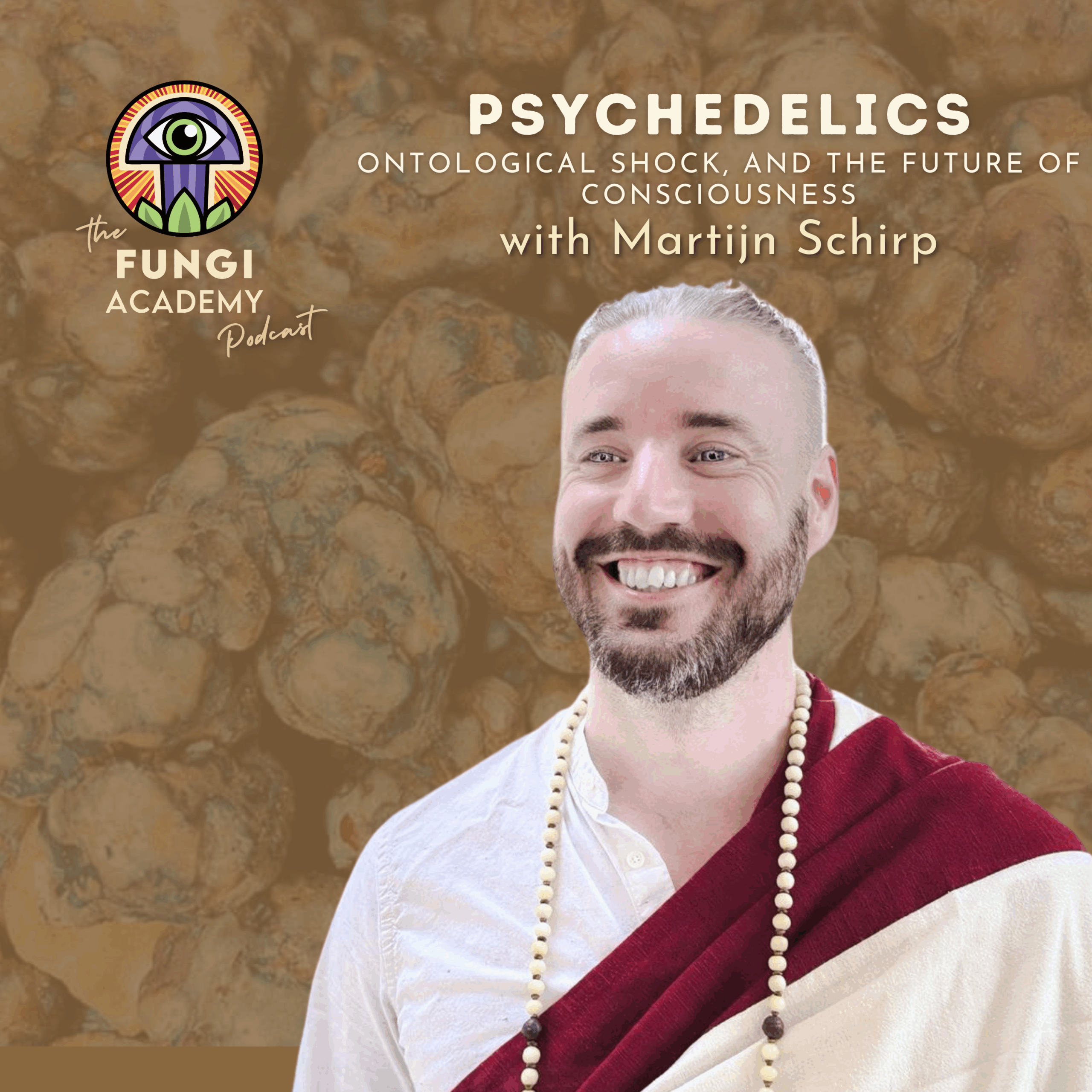
🎙️ Episode 3 – Psychedelics, Ontological Shock, and the Future of Consciousness with Martijn Schirp
🪷Check out Martijn’s upcoming program: a Path Between Worlds
🎙️Support this Podcast by becoming a Mushroom Member
Psychedelic entrepreneur Martijn Schirp explores the future of consciousness, capitalism, and community. From retreats in the Netherlands to Buddhist‑inspired practice, this episode dives into how psychedelics can help us navigate collapse and build new ways of living together.
In this episode of the Fungi Academy Podcast, Martijn Schirp serial psychedelic entrepreneur, co‑founder of High Existence and Synthesis Institute, and now founder of Upaiosis, shares his journey from pioneering retreats in the Netherlands to training the first wave of psychedelic-assisted psychotherapy facilitators in Oregon. His latest project fuses Buddhist wisdom with psychedelic practice, offering a year‑long cohort designed to explore consciousness in community.
TRANSCRIPT
Jasper Degenaars (00:00.524)
Hello and welcome to the third episode of the Fungi Academy podcast already. Today my guest is Martijn Scherp and Martijn is a serial psychedelic entrepreneur starting with high existence, writing a very viral blog about microdosing actually and many other things, but that’s just one of the things I know. And also the co-founder of Synthesis that started as one of the first, if not the first modern retreats.
organization in the world based in the Netherlands psychedelic group and moving on to start synthesis institute one of the first organizations based in Oregon training the first wave of psychedelic psychotherapy psychedelic assisted psychotherapy facilitators in Oregon
And he’s telling a story and he’s talking about his new project, Upaiosis, where he fuses psychedelic practice and Buddhism. And his first cohort, year-long cohort, is coming up at the beginning of the year. There’s going to be a link in the show notes, so make sure to check it out. yeah, this show is made possible by our Mushroom members. Go check out the Mushroom membership if you want to support this podcast and all the other fun fungal things we’re doing.
also in the show notes. And without further ado, Martijn Scherp. Martijn. Yes. We’ve both been in the psychedelic scene or industry for quite some time. Also being from the Netherlands. We’ve seen a lot of change happen over time and it became a lot more popular. What are some of the challenges that you see with this rising popularity?
I think generally our culture is not really prepared to make sense of these experiences. Like it’s often said these experiences can be so overwhelming and so undermining of what we believe is true that they can lead to something called ontological shock. for those who don’t know, ontology is the philosophy or the science of what is real.
Jasper Degenaars (02:23.029)
And often like what we saw with synthesis, for example, people can have such beautiful, but also sometimes disturbing and uncanny experiences that I don’t quite know how to make sense of. Like, was that really real or not? And so we come from a culture that is still very much dominated by dualistic thinking. Like we make very hard categories, ontological categories between
things like what’s inside us, like what is mind and what is matter. What’s mind is active and provides meaning, whereas matters is completely passive and it’s just standing there ready to be made sense of. And what we see in all of the science, that’s not true at all. Like these categories are very, very fluid. And under psychedelics,
it becomes very obvious those things are very fluid. We don’t necessarily have the language or the understanding or the metaphysics to really, I think.
best use these experiences constructively and skillfully in such a way that we can move out of these dualities. And I think what’s, if you look at the, sociology has gone, anthropology, philosophy, that these dualities that we assume are true, but actually are not,
true at all, they’re just how we look at things cause a lot of harm because what we’re finding also through psychedelic science, but also through science of meditation, that things appear like how reality appears to us is very much dependent on how we look. And so we have to take stock of
Jasper Degenaars (04:31.949)
Well, what are our assumptions? What is real or not? What kind of things do we allow to exist? And so what you see now, like when I got started in the psychedelic scene, which is almost 15 years ago now, and professionally about 10 years, like in the beginning it was like this very creative, relatively small kind of geek
community that were very interested in, very pure, very innocent in a way. It was kind of exploratory, it’s like we’re exploring consciousness, that’s what it felt like. Exactly, exactly. And it was still very much like you couldn’t really study this scientifically, like only very few people would do that because otherwise it would be career suicide. you know, there was almost no external influence on
kind of the scene. There was no huge influx of capital. There were no industry incentives. so it was very different world. then some more research came out that became very public. Lots of capital flowed in and first public companies. And
And now there has been a huge rush to the market, the much rush sometimes called and that offers a lot of possibilities because with money you can create a lot of things. without the funding that we got with Synthesis, we would have not been able to develop the different models that we did and the different trainings and such.
At the same time, there’s with money comes strings attached. so we cannot pretend that those influences are not shaping the market in certain ways. And I think there was like a really big expose that came out recently from symposia regarding the framing and the…
Jasper Degenaars (06:56.513)
the political maneuvering that happens, who gets to sit on the table, who gets to say what it is. And those things are, I think, expected that happens in every industry. But what is often not necessarily taken into account, that that determines how we can use psychedelics, what psychedelics are, what those experiences are. And I think
What I’ve seen is that it kind of blindly narrows the potential psychedelics and it narrows our view on how we can use these skillfully. For example, one of the very dominant assumptions that people take is that you take a psychedelic and then you go for a ride, right? And it’s like, this is passive thing.
And that’s based on this dualistic assumption, this ontological assumption where all meaning comes from the mind and, you know, the psychedelic changes your mind, mind revealing, and that’s it. But this is not, if you look critically, that’s actually not true. It’s the meaning is not only in the mind and psychedelic experience is not purely passive receiving some kind of experience.
What’s much more accurate is that psychedelic engagement is a co-creative act. It’s a participatory act. It’s a dance. It’s a dance. It’s dance with actually with ontology, with the range of things that you assume can be real. And that’s fascinating because then you can look at all these other different cultures
that have very, very different ontologies. And then you can start to see, wow. And this often happens on the psychedelics where people take something, especially in nature, and suddenly the trees start to speak. And it becomes the most obvious thing that plants are conscious. And there’s almost a compassionate giving that happens because they’re basically soaking up all the sunlight and then feeding.
Jasper Degenaars (09:23.071)
on every almost every organism on the planet. And that’s not how we normally perceive. We perceive plants as passive and we can extract and manipulate and as much as we want. And what we don’t see are these unintended consequences. I, and I, what I, what I’m, you know, what I’m hesitant to say, but what I think is happening is the psychedelic space is being colonized by these extractive modes of
of looking that there is this molecule and now we can basically tinker with it little bit. It’s slightly different or tinker a little bit with delivery mode. And then I’m going to be the first who did that. And then I can patent that. if I’m the first to go to all these hoops to prove that it’s safe and it has some form of efficacy, then I can determine, I get out
I can determine who gets to give it under which conditions. For what price. For what price. And I think we saw that like a while back when I forget what company was like making patents. I’m like having blankets. Oh yeah. Like all of this bullshit. Compass pathways. Well, I’ve never met any of them, like from the practices, like that’s exactly what like they represent a lot of this capitalistic…
colonialistic attitudes that’s creating, that changed this psychedelic community that was a lot of most, you know, not only, like mostly men 15 years or so, I guess as far as I remember, at least in the Netherlands, that were just trying to explore something and it became this almost elitist thing where like a lot of these experiences were really expensive. I just gave a lecture somewhere where some
was talking to I think they went on their field trip way back in Germany and like they wanted to have a weekend experience and those was 5,000 euros and you had to figure out your own hotel room and stuff like that yeah and like those are the forces that like I’ve been seeing and that like I hear you reflect as well which
Jasper Degenaars (11:40.745)
you know, Compass Pathways also working on like finding molecules that don’t give you the experience, right? Non psychedelic psychedelic. Yeah. And it’s like, kind of comes back to this, this clip of this comedian that like, it’s just so true when his friends are like trying to convince him to microdose so that he can be more efficient at work. Right. It’s just like, we’re completely lost, like the gist of it. And yes, people do have these beautiful experiences where they finally realize that
that plans are also active and plans are maybe even sentient and conscious and all of these other things that we normally reserve for humans only. But yeah, it’s like both, right? It’s just unfortunate it seems that the mainstream psychedelic wave is going in that unfortunate direction that we were just describing. But then there’s also the alternative scene.
like here on Lake Atitlan, but there’s still people in their early 20s that like will have a first psychedelic experience without like a psychotherapist. Like when they go naked under a waterfall and feel that the earth is alive and that we’re all one and it’s this dual experience and I don’t think there’s a duality because I there’s overlap but it’s a shame that both cannot learn more from each other.
I think the alternative scene is try to learn from the mainstream wave, but the mainstream wave is just going so capitalistic that I see lot of people in my community be like, I don’t really want to associate with that. Yeah. What I think is, I think the invitation is to keep learning from each other. I think synthesis was very expensive, but
At the same time, think we learned a lot about safety and proper protocol and training and all these things that did not exist and couldn’t exist in the underground because you couldn’t really organize together. And certain things can only become clear when people organize and work together. and at same time, like people can have tremendous, beautiful experiences in, you know, what would be
Jasper Degenaars (14:02.125)
probably we would never want to be in a setting like that, in like a sterile hospital room or something. And at the same time, I think this invites us to, like we have these amazing experiences and they reveal the perhaps the non-locality of mind and the tremendous potential of transformation and human consciousness in collaboration with
You know, basically as a force of creation of the universe, the world building effect of pure attention and mind and language and all these things. At the same time, if it’s just colonized by this extracted mindset, we remain blind to kind of the next phase, which is, okay, we have these experiences, now
what does that actually mean for our coexistence, for how we live together? And one of the things that I’m, I guess I’m slightly concerned about is we can have these experiences and then they just remain an experience. They remain, I had this transformative peak experience and over time it becomes this really cool memory, but it doesn’t really impact
the ground, the soil in which we live. And I think that’s a significant missed opportunity because in the context of the destabilization of basically all the institutions that we grew up with and we’ve perhaps mistakenly thought, these are so stable. Everything is going to move towards democracy. This is the end of history.
Like all these things are clearly not true. It seems to be significant regression and inability to deal with some of the really big crisis of our time. We live in a post-truth world where whoever has the megaphone gets to decide the narrative and it’s completely disconnected from reality. And what you see is if psychedelics are being used in that context, it leads to…
Jasper Degenaars (16:29.633)
you know, false beliefs, alternative facts, know, conspiracy, spirituality. and so dissonance too. like psychedelic induced ego inflation that rampant. And, so it’s easy to project that on, on psychedelics. what I think we need to look at the, the, the, the networks of, of different things that
co-arise to make a container in which we operate. So for example, if you ingest alternative media and conspiracy theories and take psychedelics, can easily drift very, very far away. And then if you choose the wrong anthology, it’s relatively easy to get psychotic in some ways.
and so the question is, and there’s this philosopher called Bruno Latour, who I’m very fond of. And he says, we have to get out of this dichotomy between, things that are real or unreal. Some things can be more real and some things can be less real and things can be fabricated. Like he basically studied, science and technology a lot. said every scientific fact.
is a form of fabrication. They’re dependent on the way the scientist approaches a topic. It’s dependent on how the thing he studies speaks to him. And it depends on his language and his instruments and his devices and how to capture that fact. And so he basically revealed under this duality, ontological duality,
of the world being passive, no, that’s not true at all. That’s not how scientists operate. They believe they operate that way. But actually, you closely describe it, that’s not the case. And so that means we have an opportunity, I think, to think very critically, or the way he would say, take the ownership of how to compose the right set and setting and ritual that we create
Jasper Degenaars (18:49.845)
an understanding that’s built well. the better things are built, the doer they are. And so we have to get out this idea that things are unreal when they’re fabricated. And I’m saying this because we’re always already fabricating our subjectivity and our perception of the world. We cannot escape that.
And so pretending that the world is objectively real and we just have to approach it and look at it from the right angle is an illusion. seeing it that way, we can then take ownership of the containers and the practices and the beliefs and the assumptions that we want to integrate into the psychedelic field. And then the question becomes, do we want extractive colonial ways of relating to
a client or to a patient, you know, is the patient sick because there’s something wrong inherently with their subjectivity? Or is the patient sick because the context in which they live is not supporting them? And then you can look at this more integrative form of regarding what’s their nature connectedness, what’s that purpose? Like what’s their connection to something that
is inherently meaningful to them. connected to their community, right? Community is huge. This is a big thing I see as well when somebody by themselves goes and has this experience and nobody around them has this experience and then suddenly you feel alone in the world and like often new communities build from that but isn’t it more powerful if you like have those experiences with your family, with your community that we…
And I think that’s the bigger issue that we have is like we’re lacking rites of passage, right? Absolutely. I think though that is the roots that all of these negative cascades that we find ourselves into are based upon because a lot of them are just boys. have a lot of men in power that have never gone through that initiation. They don’t know what it means to be…
Jasper Degenaars (21:12.747)
like an adult and taking care and taking responsibility. I think Trump is the best example of that. This person is just like trying to avoid any negative feedback and just thinks they’re the best. And that’s like the pinnacle of a non-initiated man. I think Psychedetics can be a good tool for that. But it’s not the only tool. And it’s like, do you use those lessons and integrate that in your community?
Well, I think the, the tourist message is this is assembling the social that we need to, like, even if you haven’t, like, let’s say, this is kind of the critique, I think in a nutshell that I have is people can go to the Amazon and have tremendous, beautiful initiations. And then they come back and there is no infrastructure that supports that initiation. like you said, there’s loneliness, there’s no, there’s not a shared.
understanding is not a shared way of looking and there’s not a shared intention to integrate those initiations and those insights into actual meaning making rituals, into agreements, into different ways of life. And so it’s very scattered. so most psychedelic youth is still very much possessed or under the sway of the notion of individualism.
Like I’m an individual, my individual experience and that’s the thing that’s most important. And that’s what the models are showing as well now, right? Like, we should have one psychotherapist with one patient in general and that’s what I love what you guys did with synthesis to show actually there’s more efficacy in these experiences when it’s done in a group setting. yeah. Almost all of our suffering is interpersonal and almost all of our learning is interpersonal. And so we
continually learn through the eyes of others. Like, I can easily profess like the little wisdom that I have, what is not mine. Like I learned it from others and they learned from others. And so that’s one of the things that we are connected to our ancestors. Well, that’s not something that’s very cognizant. It’s not something we intentionally bring our minds to. And so that’s one of the many aspects that are very important of our lives, but
Jasper Degenaars (23:37.961)
are completely forgotten in this modern media-driven hallucination, controlled hallucination. But it’s like this hypnosis where we are very much constantly tricked by these very abstract notions that have no relevance to our direct life that are happening somewhere else. And that’s kind of where we spend most of our attention.
And so my, my question after synthesis has been, okay, if, if psychedelics are very much dependent, like what psychedelics are is dependent on how you use them, how you see them with whom you use them for what purpose, then that becomes the big question. And so looking at some different models, like what are some non-Western ways where we can remember
some of the things that we’ve forgotten, like our connection to the earth, for example, which is creating unforeseen suffering in the world. the way of life is incredibly unsustainable and unstable. And so we need to find different ways of relating to the world, to phenomena, to our subjectivity. And psychedelics can be a beautiful
active agent within that process, but we need to mature and really understand how to, how to best work with it. And, and so different models could be, for example, the Sontadime where, it’s much less about the experience and much more about what, how can the experience actually fuel this transformation and, and expresses itself and how we relate to each other and how
how we show up as ethical beings in the world. So it moves away from this individual focus, even though experiences are important, they’re not kind of the main menu. And even though people might start being curious about this experience, the goal of long-term practice is actually how we show up in the community. And I think that is a potential model that
Jasper Degenaars (26:02.817)
will become more more important as these old institutions start to be less… Collapse? Collapse, yeah, like being less capable to provide the needs that we need. Like what we’re seeing now is like… It’s like you see in the Netherlands, for example, with the forever chemicals, our government is not able to regulate so our bodies and our children are not getting poisoned.
It’s utter failure. so same with carbon dioxide poison, like the amount of ecosystem that have already collapsed and the species that have gone extinct, that are part of this wide network of life that all life depends on, it’s like we’re playing Russian roulette right now. And we shot a few times, we’re still here, but the bullet is coming. And that’s the thing that
Causes a lot of people to like, I don’t want to think about that because it’s such a big thing. And what can I do as an individual? But at the same time it is coming and we can’t close our eyes because that will not help us prepare and find new ways of working together. we can, we can at least,
Jasper Degenaars (27:29.293)
Hopefully, you know, live with some dignity through this transition. And as opposed to these extreme escalations that we’ve seen in conflict, especially in the last century, where, know, unfold suffering happened because of some ideology that was, you know, people were contagiously possessed by
and justify this crazy amount of damage and killing. And I think that’s what we’re seeing now with all these critical zones, especially the places that are impacted by climate change. know, significant scarcity happens. All these people have nothing to lose. What happens is conflict. And we are not seeing any clear solution except
violence and otherizing people. And I think that’s not going to end well. Yeah. I see you on the other end as well when catastrophe happens. And yes, that’s one way to move forward. But when you see these communities being more connected, right? And that’s the big shame of the time we’re living, if you study history a little bit, you see how much effort, especially United States, is put into disconnecting
communities from each other all over the world because that’s Kissinger politics right if the whole world is in chaos you’re in your stable you’re doing good yeah and it doesn’t matter who you attack as long as you could pretend they were the bad guy even though there was no proof yeah Libya and Iraq and and but I think there’s the other side as well right because like as somebody who studies history like I think it’s funny that people are like we’re they like we’re gonna be
going through the age of collapse, like this world was gonna live forever, but if you study history for five seconds, you notice that everybody thinks that their world was gonna be there forever. Right. Greeks thought that, the Romans thought that, like we’re already living in post-apocalyptic world because apocalypse is a Greek word and their world is no longer there. So change always happens and like, although maybe in a more global scale, I don’t know if we’re gonna get to some of solutions. I think it’s, again,
Jasper Degenaars (29:54.285)
And I think this is actually interesting to point out of like what you said earlier in your conversation of this idea of dualities. It’s just going to be this one way. It’s going to be this one way. It’s either going to be like perfect climate or chaos completely. And I think there’s always more nuance and balance. I think this part of the worlds that are unfortunately going to go through what you just described. But I also think there’s parts of the worlds that are going to be that like people are going to unite. Exactly.
I want to be part of that group. I want to be part of that group too. I think that’s why we get along. No, I really love what you said about the apocalypse because… You know…
to many indigenous people, like the apocalypse has already happened. many of their relatives and peoples have completely disappeared. Their languages, their ways of life, the white rich biodiversity in which they depended, completely gone. And so the amount of colonization that has already happened, like we perceive it as normal.
because we grew up in that world. But if you sat on the other side, the apocalypse has already happened for them. And that same logic is coming for us as well. We just pretend that’s not, we’re kind of somewhat human exceptional and we’re not seeing that because we’re bounded in what Charles Taylor called this buffered self. But we’re not buffered. We’re incredibly porous, which take a high dose of psychedelics and you see how we’re constantly
You know, we have intrusive thoughts. have, we get the news and suddenly we have an explosion of emotions. Like we’re not buffered. We’re still open and we are open to pollution. We are open to ideology. We’re open to, you know, the different types of the day. And that means there’s also an opportunity. We can be open to each other and we can be open to look at.
Jasper Degenaars (32:01.933)
voices that are currently not prominent in the psychedelic field, those of indigenous people that say, wait a minute, that whole extractive way of is not sacred. It’s not really caring for the medicine. It’s not really caring and healing for the soul. so I think that’s something to be taken seriously. so there’s one anthropologist
wrote a book called The Mushroom at the End of the World. Yeah, you know him? Anad Singh, think the name is. Yeah, I read the book. You read the book? Cool. Yeah, so. about Masutaki, right? Exactly. And I think part of the book, I haven’t fully read it, but I got very interested in the ideas within it. And she argues that we need to learn how to live in ruins, like the ruins of
capitalism and I think that there’s a message there that if we want to build collectives between the different forces in the universe, between humans and non-humans, like you guys work with mushrooms and are dependent on mushrooms. all are dependent on fungi. Fungi and plants and animals and…
And we said animals in another bounce. Exactly. And it’s like I’m here. And I think it’s so easy if you’re completely grown up in the abstract notions of humanity, all you see is human symbols and signs. You can forget this original, what my little buddy called this original, it can be so easily forgotten, our embodied existence. And psychedelics…
if properly used in the right context of practice, community, this ontological openness that we actually don’t know exactly what is true or not. But we can see the suffering that’s happening and the destruction and we can choose sides to participate or not and to build different worlds. I think there might be maybe not a cure.
Jasper Degenaars (34:23.831)
for our ailments, as Bronell2 calls it, treatment. And that maybe that’s the best we got. so that’s the… Personally, I find nothing more interesting and that’s the thing that I want to spend all my time doing. I’ve lived through the capitalist dream and I found it to be quite empty. And I…
since found refuge in a wisdom tradition that’s deeply meaningful and within that tradition, within Buddhism, the whole purpose is this, in my school Buddhism is the Bodhisattva ideal which is your own awakening. Awakening is possible, that’s one part of the ontology and at same time your awakening is not separate from the liberation and awakening of all other beings, all sentient beings.
And to me that includes plants, microbes, even rivers, rivers and the elements. I think that that’s such a different way of looking, but it’s completely in coherence with more indigenous ways of knowing. And that’s almost inherently, no matter where you look, there’s meaning and purpose. And it completely fills me.
as opposed from this nihilistic, more scientific ways of looking where, well, everything is just dead matter and the universe is empty versus, no, the universe is wildly alive and full of voices, full of beings that most of which we can’t even perceive. And you can live in that. And that’s something I’m very excited about. But you have to fabricate that in a way that’s built well.
It needs to be, if you can’t, like what I think is a problem is you can’t just take anything, you know? You can’t just, the world’s not completely make believe, even though that might, you might think you can communicate with aliens, but you need significant evidence for that. can’t just- If somebody gets meaning out of that, I’m not saying I do that. So like that’s, I think meaning is so subjective.
Jasper Degenaars (36:50.445)
And if somebody gets a lot of clarity and meaning out of channeling, for example, which is a lot of people, then I don’t want to just claim that. So I’m more on your side, of course, because I’m a scientist at heart and for me, my meaning has to do with just being able to absorb the wonders of the natural world. I think that’s our role in the cosmos is to be there to just kind of look at the
beautiful spectacle of life is like, wow, this is incredible. I found just a lot of meaning in that. That’s why I’m interested in learning about fungi and plants and astronomy and all of these different fields of study because it’s like, wow, that’s what we live in. If somebody gets a lot of meaning out of channeling language and feeling healing out of that, does there have to be sort of empirical or provable evidence in that?
I think I’ve nuanced what I just said. So I’m not saying that’s not real or not meaningful for them. And I think the question through psychedelics and also through Buddhism is this ontological openness where many different forms of ontological worlds can exist. And in the context of if you believe that aliens are true and you have a practice in which
alien beings show up in your, your reality. then that can be complete ontological world that has so that has enough empirical evidence that within that context, that’s true for these people. And, and it can be very meaningful and perhaps it can even be skillful, but that’s kind of the question is like, is it coherent with,
other forms of knowledge and wisdom and what’s the intent behind it, what’s the purpose behind it and how it’s being used. if it doesn’t, so this is, for example, one example, what I found in the early adoption of Ayahuasca, example, is… What do mean by early adoption of Ayahuasca? For example, let’s say 10 years ago, people would go to the Amazon,
Jasper Degenaars (39:15.993)
and have this tremendous transformative experience. they would, through that experience, they would adopt a more, let’s say, jungle cosmology. With the ayahuasca told me this. Yeah. That’s a very common, like, mother ayahuasca told me I should become a shaman kind of thing. Classic. And that’s the adoption of that, you know, within the context of what they experienced, very true.
I don’t want to undermine the validity of that, but at the same time, is it built well? Can other people depend on that quality of, well, because the ayahuasca told me, I should then have the power or the say or the competence to actually lead ceremony. And that’s kind of where the crux of the matter is. Certain forms of beliefs don’t necessarily fit very well in a collective.
They don’t fit with other forms of knowledge that are also really important. And so the question then becomes not again this duality between, if I believe this, that excludes this. No, can they work together? What are the different needs? What are the different negotiations? And that comes, I think, the question of our age. what in a post-truth world, like what kind of realities do we
Jasper Degenaars (40:48.523)
Do we tolerate and what are the consequences of those reality? What are the impacts? And some might be better than others, but we need to find some form of discernment between what is being skillful? What is bringing us to more connection? What helps us to develop actual solutions to the problems of our times as opposed to, well, this is something you really believe in and that’s really works for you.
but it doesn’t necessarily work in all of the other domains, then the skillfulness is limited. It doesn’t mean it’s not true or not, but outside of that dichotomy, it’s like, is this something that if our whole collective would adopt, we would be better off, we would be more resilient, we be more connected, we would be more honoring the whole assemblage on which we depend.
And then I think you can discern between different wisdom traditions, different ontologies, different epistemologies, forms of science. Science is not as unified capital thing. Scientists are very, very divided. Within every single discipline, there’s tremendous conflict. And that expresses itself through funding, through grants, through being cited the most, like this competition.
And so… It’s also ego, right? And be like, my idea. Personal incentives. incentives. also like, if almost like if this fight for truths and then like, obviously there’s also the claim of like, that was Hogus science or that is pseudoscience because your ideas and like your conclusions are not in line with what we are thinking and saying. Yeah, exactly. It’s very hard to demarcate between science and pseudoscience.
And I think was Poon who said it, that next paradigms don’t happen because of new evidence or new theories, because when the old generation passes away. And then suddenly there’s room, this breathing room, this ontological breathing room, to finally consider the accumulation of new ways of looking. that becomes embodied in this network of instruments and facts and
Jasper Degenaars (43:12.267)
and documents and books and media and all that comes together to create this ontological world that then becomes true. I think, then people believe, this must be the true one because you can’t look outside it. And this will be the one that’s same with the Romans and the Victorians. Like this world always exists. And that’s, think, if you look at history, that’s simply not a case that can be made. so then, and that implies this question, okay, what is skillful or what is not?
And so, and I think within that you can, or we’re kind of confronted. Do you believe the climate change denial? You know, that’s one way of looking, that’s probably very real for a set of people. And they can find evidence for that. Or do you look at the different side of evidence and see, shit, we’re kind of in a pickle here.
And that’s a moral choice, it’s an ethical choice. I think the tremendous impact of that choice, the commitment that we have towards what we believe is incredibly far reaching. It’s at the core of our existence. It determines what we perceive as true or not.
how other people appear to us, it appears like our own subjectivity can be incredibly… in one end of the spectrum, create a lot of suffering, or it can create liberation and awakening. And so I think this is the beauty that psychedelics can provide us, it can show those possibilities and the far reachingness of
of how we hold things. And I think that is a tremendous responsibility because we can’t just fall back to our Christian heritage where whatever happens, God determines it or science will or nature will solve it. No, it’s up to us. And so tremendous responsibility and tremendous
Jasper Degenaars (45:39.405)
that I think is happening now in this age transition. Exciting times. think I wish a philosopher, think he was ancient Greek or something and I read it once like, and he was like writing a memoir for future generations and he said like, maybe live in interesting times or something along those lines. And I think a lot of us like, think the times have been interesting enough, can we live in boring times? I remember that.
Maybe it’s misquoted somewhere in history, but I remember it being a Chinese curse almost, where you wish your enemy to live in interesting times. okay, maybe different philosophies, right? Where in like this one guy in Greece was like, it’s too chill and he’s reading about all these wars and all this like political turmoil. Like that sounds interesting. I’m just bored. And this Chinese person sees it from the other way around. Yeah. Yeah. I think there’s also, there’s this, on this topic, there’s a
think there’s a Russian utopic science fiction story where everything is perfect and people get so bored they will start destroying the perfectness so they have some kind of form of hubris, some kind of unexpected. And it’s also the creation story where God perceived everything that’s gonna happen. So the only thing that, the only limit that God has is forgetting itself, that it is so all-powerful so it can be surprised again.
I think, Alain, what’s talked about is that if you are able to dream everything you can ever imagine for an infinite amount of time, then at one point you want to start dreaming something unexpected. Yeah, novelty is the spice of life, always. So… But it’s also looking at it from a very anthropomorphized point of view of life, because we want that as humans and seeing that, like…
representing that on DT’s as well. Well, I wanna like roll back a little bit because we said the name Synthesis a couple of times. And maybe some of the listeners I knew into the psychedelic scene or like just rolled into it with just the focus on mushrooms. And you were the founder of First Synthesis Retreats. Co-founder. Co-founder, exactly. Can you tell us like what Synthesis Retreats was?
Jasper Degenaars (48:05.149)
Like how it evolved and kind of the journey. How did it start? think is a good… Yeah. When did it start? It started when I was, I think, 29. And I was speaking with Paul Austin, the founder of Third Wave, that there seemed to be a change happening. Like psychedelics changed from…
this thing that some people were interested in, but only kind of crazy hippies are into actual valid, creating valid modes of perception, like valid modes of visionary experience. And there was more research happening and more media interest. And I wrote a article on microdosing, I think in 2014 for my website, High Existence. And I think it got read like 20 million times or something.
Like, it’s not the microdosing, that’s something I invented, but I, I got interested in psychedelics and then I got interested in microdosing and I ran a set of experiments and like, this is, this is fascinating. This is, there’s one way to be skillful with psychedelics. and Paul, I think read that article and it’s like, and then the others, and he, he built this website around microdosing. And so we became friends and.
we started touring different business conferences that got interested in psychedelics. And people were interested not just in microdosing, but what’s the full dose like? And there was a set of people that I never imagined would be interested in psychedelics because it was so limited to people like me, which were nerds and geeks and people who were kind of on the…
wouldn’t say in a personality spectrum, but kind of out there. And these were people in suits and people with careers and high functioning, you know, and it’s like, okay, there seems to be, they consider it’s like the technology and there’s an adaption curve. And what we’re seeing now is like the next phase of adoption. And the question we got often was, where can I have experiences like this?
Jasper Degenaars (50:30.341)
And, you know, I would, talk about my ayahuasca experiences and then we’re like, no, no, not like that. Like something more modern. and so that kind of seeded the idea. It’s like, okay, what would the modern container look like that could, invite a wide variety of different intentions, both recreational, both like optimization and healing.
and spiritual, those were like the four main things. Well, because we were talking business context, the first version of synthesis was actually come and solve your creative problems. And we ran our first pilot and only one out of 24 people were interested in that aspect. Almost everyone was interested in either healing or these bigger spiritual questions like the meaning of life, what is consciousness?
Um, you know, who am I, what am I supposed to do in the world? That type of thing. Um, and, and the timing was, the timing was, um, was very fortunate because, um, we ran our pilots. They filled up relatively quickly in 2018, the beginning. And then after like a month after our pilot retreats, Michael Palm’s book came out and, um,
Interest quadrupled overnight. we, you know, with people that wanted to work, basically, I think one third of our participants then started like, Hey, can I, this is what I want to do with live. is so purposeful, so meaningful. have these group experiences and the connection that people experienced was unlike anything they experienced. And the people that were attracted to, were, to the team were
very talented, you know, I think we had such a beautiful talented team. Like people really cared about working well with psychedelics, like really honoring the experience and honoring the safety and honoring the responsibility in space. And that just grew like, yeah, unexpectedly fast. It was like a rocket ship. Like within six months, we,
Jasper Degenaars (52:55.277)
We had investors saying, hey, this is great. If I would give you this X amount of capital, what could you build with that? I was like, well, I have plenty of ideas that we can build. And so we started developing business plans and started hiring more management. within five years, we had like 80, 90 people working. We had centers in the Netherlands and Oregon. We developed a training with 300 students there.
which was based in this ontological, pluralistic, ontological, many ways of knowing that honored both the things like intergenerational trauma, but also nature connectedness and being indigenous to this planet. And that worked well. And so that grew really quickly. we grew too quickly.
And there are many, I think there are many co-factors that conspired at one point to make it unsustainable. And at the beginning of 2023, basically after five years of this insane vortex, we had to close doors and the training was acquired by Utukuru and it’s still going on and still doing really beautiful work, but I’m no longer involved.
What were some of those factors you think?
Jasper Degenaars (54:32.589)
I think.
Jasper Degenaars (54:36.759)
Yes, yeah, of course. Thanks. Let’s see.
I think COVID was a big one. Like we had a beautiful retreat, a small team, very close. And when COVID happened, we lost all of our, we basically lost our business model overnight. And at the time I was still CEO of the company and I really struggled with that. I did not know how to, I felt such a responsibility for the investors and the team.
that it impacted me quite profoundly. And in that impact, we didn’t have much time. Like we were running out of runway pretty quickly. And so there were some views in the company that would be better to hand the leadership to someone else. And I was very cognizant of my own limitations.
You it very well be that I’m not the best person to lead this anymore. And so I stepped down as CEO. And we successfully pivoted the whole company into a training company with retreats, but we passed the retreats until after COVID, after we reopen. that was the right decision. We were continually able to grow and
But one of the things that because we got investment, there was this mandate, we need to grow, we always keep focusing on growing. And we were going so quickly that I think some of the foundational aspects that we should have gotten in order were not in order. And so over time, what happened is like different camps. We had like an American camp and a Dutch camp. know, culture and time zone different and purpose different.
Jasper Degenaars (56:44.173)
We had camps between the board level on the C levels, the executive level and between the retreat side of business and the training side of business. And it became harder and harder to mend between the differences. It became too fragmented. It became fragmented. And what was incredibly painful is that we, at one point, I think it became too hard to really work together.
And I did not manage to see eye eye with certain people in the company. And I think vice versa, happened too. Not because they’re bad people or because they’re necessarily, they had wrong intentions. I think they just have a very different conception of what the company should be. And I was not able to let go of my conception. I was not able to step back. What was your conception? I felt that the essence of the company was the work itself.
work itself a sacred and like the our roots in the Netherlands like I could not conceive a way that we could not figure out a way to work make that work and there was a different conception that we had to kind of split that off or close that down completely and for me I did not want to let go of that aspect of the business and of that team I thought it was the heart and soul of the company.
And the decision, I felt the decision that was put forward, I was not able to recognize that. And we had acquired a center in Oregon and there were delays there and political issues and it became much more expensive and there were all these like unexpected costs that we did not anticipate.
Because there was so much fracture, we were not able to find the funding that we needed to, the bridge funding that we needed to basically solve some of those issues. And so we had to file for bankruptcy. What are some of the lessons that you’ve got out of that experience?
Jasper Degenaars (59:12.261)
I spent the last two years, cleaning up the legal mess, by myself, mainly I’ve had support from lawyers and other people that, but, let’s get like everybody, jump chip, understandably. So like if I were in their position, I probably would have done the same thing. So there’s no blame on my end.
But my position happened to be such that somebody had to be supporting the investigation into the reasons of bankruptcy and there’s a whole process in Netherlands, it’s very well regulated. And actually you got news today that it’s over. So I’m very… Yeah, was a very painful two years because I had to spend a lot of time basically digging through all the…
emails and all the decisions and basically justifying all the things that we, you know, everything constituted the decisions that we made. the last two years I’ve been reliving every decision of the company that led to its bankruptcy. So not necessarily something I’m very proud of.
Lessons. think one of the big ones is relationship is almost everything. Like the ethics, even though ethics was at the core, we felt we fell short of actually living because of the pace, because of the incentives, because of the disagreements. We did not walk the talk.
And, and, and part of that is, I think is on me because we did not do the foundational work that a company like that requires, like the kind of the ontological work, the theory of change, the pedagogy, the, we, we built it as we went along. And because we went, because we had such a talented team, did a pretty good job, but at the same time, there were already cracks at the very beginning that we were never able to fully
Jasper Degenaars (01:01:40.813)
bridge. And so I spent the last two years, two years contemplating, like, what are those gaps? And part of those gaps were in my own subjectivity, in my own assumptions about reality. Like, it was a very individualistic Western approach to psychedelics. And I don’t necessarily believe in that anymore. And so I rooted myself now in
in the wisdom tradition I’m most familiar with in a way to like, what can we learn from, driven that already exists from thousands of years? Like what can the psychedelic space learn from Buddhism, for example? And that’s been my leading question to build this foundational work first before I put anything in, in, in, assembling anything again. and I think I, I’m much more.
patient, like I think a big part of it is that we saw an opportunity, we saw a timely opportunity and we wanted to be, we want to take that opportunity. And I was young and I was very much identified with an entrepreneurial mindset. And I don’t necessarily believe that anymore. thought, know, I thought psychedelics, scaling psychedelics would necessarily kind of
It was very naive and idealistic. If you scale psychedelics that automatically lead to more ethical, more ecological ways of being. And that’s clearly not true. So the container is much more important. I think that’s probably the container consists of the people and the beliefs and the assumptions and the documents and agreements, the ethical commitments, the…
who has a shareholding incentive within the company, who are the advisors, it’s this collective ecology that creates the container. And I think we did a tremendous job with Synthesis. And at the same time, I think it was built on a shaky logic, that shaky foundation, shaky, I think, worldview. And that traps different peoples and different views.
Jasper Degenaars (01:04:06.293)
And that then created this opposition because people are porous and that you’re being possessed by these ontological commitments. And if they’re not explicit, and if you’re not negotiating between those explicitly, they will reveal itself in conflict and warped meetings. unfortunately I was not wise or mature enough to be
a good diplomat between those views. And I learned a lot and I think everybody within the company learned a lot. And I’m saddened by the harm that was caused by by different conflicts throughout the company and the students that were still in the program when it collapsed. And I’m glad I was able to clean up some of that karma.
in the last two years to make the least provide some conditions for people to finance their education and the company to, and some of the members still having a job. And it’s of course painful not to be part of that anymore because I really cared about it. And I was not able to steer it away from the implosion.
I think it was very humbling in a good way. And it took me some time to find footing again. It’s like, do I, can I trust myself in creating anything, know, leading anything? And then I think I do think there’s a responsibility in
making sure those lessons are not being wasted and deduce those insights and try again. And I think, because I think psychedelics have this tremendous potential and it would, you know, I always, I always believe it might take generations for us to really learn how to, you know, work with it. I think it will.
Jasper Degenaars (01:06:26.989)
because it’s kind of foolish to think that we’re just gonna figure it out. Exactly, we got the final answer. of, let’s call it, new age psychedelic users, and new age is a loaded term, but at least it’s the psychedelic renaissance, and then we’re gonna find out all the solutions instantly. It’s ridiculous. silly, right? It’s so neat. Yeah, but there was this perception, and I think there’s still this perception.
There certain companies and individuals that think like, yeah, we’re going to figure it out and everybody’s going to get there. And it’s fascinating. Yeah. think it’s really beautiful that like, yeah, you’re so reflective of it. know, psychedelics teaches about death, right? And you went through a death and, I said, you never got to meet Oliver because I think you guys would have liked each other a lot. And he was also about the scaling of the psychedelics. was like, do we need, do we need to do the scaling? And, and like,
I think his fast pace in life led to his demise. Right. As the fast pace of the growth of synthesis led to the demise of It was too fast. Yeah. It burned people out. Like my wife had a burnout for, and really gave me pause. Like, holy shit, this is. And one of my dear friends, was one of the early employees, like one of the founding members of the company, got burned out. seeing that, like, oh my God, the harm that we’re doing.
just because we’re possessed by this fervent meat. It’s not just a carrot, was like COVID destroyed. So was basically survival mode constantly. And this competition and then money and all these factors coming together that again create this constellation of factors that all speak to you and then together created this…
You know, from the outside, after the articles that came out, like seemed like insanity. Yeah. From the outside it did. From the inside, it was this vortex that we, you know, we wanted to do good. And I think we did a lot of And at the same time we had blind spots that, we were, there were no supportive conditions to really take a pause and address those. And,
Jasper Degenaars (01:08:45.837)
Yeah. And think that that’s what’s happening a lot of I think in psychedelic field still. it’s this funny thing that happens, that I found that like, if you believe like your own subjectivity is not just inside, it’s not just bounded by this being, but it’s co-determined by all these factors. Like one of the things that that was
visible to me was after synthesis. That was kind of the first time I really felt the breathing room again to question the synthesis model. Because before, like my income, my safety, my identity, all of that was dependent on buying into this model. And those factors made it such that it’s hard to stand outside. And so we are so good.
codetermined and influenced by our roles, by our expectations, by reputation, by, you know, next month, we have to explain these decisions to the board. that, that co-determines what we believe is true, what comes to the foreground, what, the gestalt is made of and what your blind spots are. And, and so I don’t, I know there are still, this is kind of the
Probably the most painful thing about synthesis is the fragmentation that happens between people that really cared and the finger blame, scapegoating, which is a very ancient mechanism where to simplify reality, one thing comes to the foreground and you say, that’s the culprit. So we just remove that. Then we can finally relax again and ease our anxiety until another scapegoat happens.
And so this escape code mechanism and that was painful after the collapse of synthesis that so many people were skateboarding each other and running to the media to tell their version of the story and say, I knew what was happening and I told them and understandably, like I had those impulses as well. But I don’t think that’s an accurate reflection of what really happened. And so
Jasper Degenaars (01:11:08.843)
I don’t hold any grudges. Thank God, it took me time to forgive and forget. Or maybe not forget, but forgive. And I hope everyone got wise through it. hopefully it’s a lesson for the space. And I hope everybody who was part of Synthesis will have tremendous influential careers through those lessons.
Because that’s how generations live, we make mistakes and hopefully we learn from them and we make sure we won’t forget them. Hopefully. Yeah, that’s our responsibility and it’s not something I take lightly. And all I can do is my best and try again. Yeah, thanks for sharing that story. I don’t know if you’ve shared that before, but I think you know so many people that were involved with synthesis.
the retreat dream to the educational team, to you and Miles and all the people and just seeing like, how much of an impact it not only had on all of you as individuals, but also in the space, right? And I hope that people here that might think of like this as the psychedelic scene as an opportunity to like take this lesson into heart, you know? And like…
So, Dan Gaimon once told me a couple years ago, I think it was with the hot sound fever, the times are urgent, let us slow down. And I think that really resonated with me when, especially during my five, early 2020s, when people felt that rush, right? The shroom boom, the blue rush, as some people has called it, right?
Yeah, I don’t know if we got better off of it in the direct results of as a society, as a community, but I hope we can get better by learning these things. And it’s something, you know, you’ve been best with the time to have a lot of introspection. what does that look like? That kind of that rebirth after, you know, you just kind of are finishing the cycle today with like the day getting the news from the Dutch government that like
Jasper Degenaars (01:13:36.173)
the bankruptcy is completely completed, is great reason to say it’s huge. great reason celebrate. Yeah, the consequence was like they would find us guilty as management and we would be on the hooks for a lot of the damages and you know and if we were responsible of course then that’s the right thing to do although I don’t think we acted in bad faith or with
Jasper Degenaars (01:14:05.805)
with incompetence. We’re just unable to solve the problems. So yeah, you two relief. So how was that then, kind of that rebirth is the word that’s coming up for me. I know you’ve been kind of going deeper in Buddhism, I’d love to talk about that, but also have you utilized psychedelics in this path or were you kind of like kept your arm off of psychedelics after what happened?
I took a huge break. I think that was pretty common from the people I’ve spoken with after Synthesis. It’s like, okay, I need breathing room. Like this went so fast and it was such a big demand. But Synthesis became its own thing and I worked crazy amount of time. I got really ill even. It took so much from me.
that I had to recuperate, I had to take a break. And so my wife and I, we spent quite a bit of time volunteering and worked in the garden with animals and with plants, which was very sweet, very nice. So a lot of digestion happened, like, cause things would just come up, like moments of intense conflict and disagreements. It like, how did I show up? Like, why was I so, why did it seem so real?
to me at that point in time, like what were those patterns, those motivations, those emotions? So it was a slow digest. And then my wife and I traveled to Nepal and Bhutan mostly to study Buddhism deeper, meditation and the contemplative path. So spend a lot of time in retreat and really digging, digging with like what are my fundamental assumptions?
Like, do I still believe in Buddhism? And if so, in what way? Like, what have I seen is its potential and what are the potential downfalls? And can I substantiate that? Can I really… Is it built well? Like, is it just my idea? Is you know, it just flippant or is it really substantiated? And so I spend the last…
Jasper Degenaars (01:16:32.749)
Two, three years, basically going back to the drawing board and rereading all my notes, all my assumptions, really go back, dig in the literature. And then over time I started building my own practice again. And I came to the yes, they have a role to play, but not in what I assumed beforehand. I think the non-directive approach, the approach that we have at Synthesis,
can do a lot of good, but there is there are some, you know, ontological hypocrisy within it. It’s not, it,
it assumes things about reality that I just don’t think are true. Or it pretends to hold this neutral worldview. And there’s no neutral worldview. And I kind of move to the other side, like I think we need to be incredibly directive. Of course, with consent and it needs to be explicit so people are totally informed beforehand.
But that’s what I’m mostly interested in now. And I was pretty hesitant to birth something new because, you know, I think through this process, I just got really aware of, you know, the risk and responsibility that comes with it. And blind spot is such that you’re not aware of it. So you should expect blind spots and that’s…
after the huge rise of synthesis and the huge collapse and having to, you know, the little things that I could clean up and the long, the amount of effort that took. Like I don’t want to, I don’t want to do that again. And at the same time, those lessons didn’t leave me alone. Like I think I, there’s,
Jasper Degenaars (01:18:45.079)
There’s a sacredness in honoring the pain and the teaching, the teachers of pain. pain is a great teacher. Deaf is a great teacher. Conflict is a great teacher. And if I want to honor my contemplative path and I want to honor the invitation of my teachers to, to really integrate my practice.
and integrate the wisdom. You know, my chapter is not done with synthesis. And synthesis was one version of a model that I think is now very common in this space. You know, I think almost all retreats have a model like that, different flavors. But if you look at history, if you look at current models like the Santa Diomy or indigenous containers, it’s a very different model.
And I think they allow us to come together as community in a way that maybe the synthesis model was not able to. And I feel like that’s my calling at the moment. And it’s not going to be the ultimate version or the end version. There’s going to be a version that I think for those who resonate with it and feel aligned and it fits well.
It’s a good synergistic resonance. I think we can create a spiritual community, a spiritual sangha that learns how to…
Jasper Degenaars (01:20:33.399)
hopefully put psychedelics and the wisdom tradition in its proper place in a way that actually provides this humbleness that I had to learn through the demise of synthesis. And it has been a very tough process to be honest. It’s been… Because after synthesis, the standard or the pressure has increased. I cannot pretend
not know certain things and those certain things, they’re not just beliefs, they’re voices and they ask something. If I honor them, they’re active. If I engage with the lessons, it’s not something passively that I can pick up or not. No, they’re basically knocking at your door if I’m doing something that’s not in alignment.
It’s like, wait a minute, you can’t do that. Cause now you know it will have this consequence. And if it has that consequence, then it will lead to something that’s not congruent, but it’s other set. So you need to negotiate and that takes a lot of time. And that’s the work that I didn’t do at the beginning of the sentence, because I didn’t know how to, or I thought I already did. And I was still very much in this duality of entrepreneurship versus
extractiveness and commodification and this whole constellation of things that I was not questioning. And I felt like I had to leave psychedelic space, I had to leave even the Western hemisphere and I had to be in the mountains and the Himalayas to be away from that constant influence so I could have enough space, kind of let myself be turned inside out and do that.
And I’m not saying I completed that work. I’m not saying I now know the answers, but I’m saying I think I know the next step at this moment in time. And that feels good. It feels challenging. It feels scary. But it also feels fine. You know, this is my fifth or sixth project. And I think Terence McKenna at one point said, find the others. And I’m finding the others that are feeling similarly.
Jasper Degenaars (01:23:01.041)
And that’s really, really cool. I’m now supported by some really amazing teachers that combine Buddhist path with psychedelic sacramental views and they’re developing their meaning and their understanding of it. And this collective thing, that’s really exciting to me. And I think for those who resonated can be a beautiful
container to deepen their practice, their awakening and their kind of bodhisattva approach to life where we have very short window of time and we cannot find the fundamental difference between self and other. And so, need a hand?
Jasper Degenaars (01:23:58.541)
yeah, that can do it.
Yeah, expressing the Bodhisattva vow of becoming a follower of Gaia, where the earth is an active force that’s much more powerful than our commitment to economy or commitment to institutions. And we have to wake up to Gaia. That’s the clear message that I think you can read from scientific facts.
And there is a.
When you listen, you’re humble and you listen to the elders of the indigenous peoples and you listen to some of the people who have taken upon themselves to really go deep in the path of awakening, there is an invitation to wean ourselves from this
infatuation with the self, this almost narcissistic self-referential belief that we are all that matters and open up this much wider, richer spiritual dimension.
Jasper Degenaars (01:25:29.141)
I think that that is something we can learn a lot from and need to learn a lot from because the ecological necessity just dials out to, you know, the water started to boil. so.
That’s what I’m committed to and I’m excited about. And I see convergence in some of the Buddhist field. I see convergence with eco-dharma. I see convergence with the most, I think, most built well understanding of the research on meditation. And there’s a huge overlap on the research of psychedelics. And so…
We have to live in this foundational less world where we cannot just…
Jasper Degenaars (01:26:24.424)
pretend we’re going to be saved or pretend that the world will provide the answers for us and it’s a practice and it’s a community, it’s a negotiation and I’m trying to figure out what’s a form that works for me with the assumption that if it’s built well in coherence with these other forms that are built well then that might
provide a step of a solution, it might provide something that works well for other people. And I think that’s been true for me, like, since this was very difficult. figuring out the process for myself, how to digest it, how to make meaning of it, how to come to it stronger, more resilient, more generous, more capacity to be there for others.
hold space and become space. That’s the proof. And as long as it works for me, I think it could work for other people. Not that I’m special or anything, but more so according to, you we these ingredients together, we get a nice nourishing meal. And I think that’s what I think a lot of people are hungry for. Like what’s the nourishing meal that we can
Jasper Degenaars (01:27:51.943)
learn how to not get swallowed by the tremendous task of the ecological crisis, the disillusionment of democracy, the alienation of technology, the sickening of corruption.
Jasper Degenaars (01:28:19.885)
I there are what I find in my own bubble, there’s a different world within my own relationships with my own friends, my partnership with my wife, with my relationship to the planet, to the plants, to the mushrooms. And if it’s possible for me, it must be possible for others. And there’s a tremendous amount of very well-built tradition and knowledge that is available to us.
And so to be dissolving our own kind of illusions and let ourselves be swallowed by the Western traditions, think is a beautiful way of being, a beautiful way of looking. Yeah, it sounds like you’ve gone through quite the hero’s journey yourself and the archetypical hero’s journey, right?
Something happened that shook your foundation, that made you feel like I have to leave, I have to distance myself from my former life. You quite literally went to the Himalayas and got teachings and now you’re also quite literally, now this chapter is done, moving back to the global north. Bringing these lessons that you’ve learned in these two years of turmoil, in these two years of self-reflection and evolution.
coming with this beautiful program with your new project called Upiosis, right? And you’re really good at explaining what’s Upiosis to you. Upiosis is kind of a new container where it takes seriously that to work with psychedelics skillfully, you need to train in a set of skills, contemplative skills, and prepare yourself with this
basically collect the right set of beliefs to do psychedelics in skillful means. So, upiosis comes from upaya, taking the process of applying skillful means in path towards awakening. And awakening is realizing we are not separate from the worldwide networks of mushrooms, of
Jasper Degenaars (01:30:46.625)
the soil, of the substrate, of the temperature, all things that polarize to give life, these very narrow Goldilocks zone. We are that. Like the air is our lungs that’s not being polluted. The water is our blood. The soil is our flesh. And I think from systems theory, from terminology, from basically all of the science
are coming to the conclusion you cannot separate the object from its context. I these were right, Exactly. And this is fundamental, I think, insight that a lot of people have in different forms on the psychedelics. And so the question is like, okay, if so, so what? Like, what do we do about that? And then, okay, you have to build the systems, have to basically build this network of beings together.
to allow for a more awakened way of relating to exist. And the first step is this one year training that I’ve developed. It’s still very, very little, but it’s like the minimum, I think, to provide for people to come together to really chew and digest some of these practices and then use that preparation to come together in a container to build this new ontology
In a way it’s not new, but it’s new with psychedelics that really allows for the awakened way of seeing ourselves and therefore seeing what we have to aim for. I think it’s the most exciting thing I’ve started to build so far. it’s the most difficult thing I’ve built because it’s
It needs to be built well. so the amount of work that has gone into it is, you could call it obsessive, but I’m enjoying it and it’s been incredibly nurturing for me. And that’s the intent behind it, to be nurturing for those who are ready to commit on this contemplative path and think.
Jasper Degenaars (01:33:11.863)
form of awakening as possible and want to tap in in the network where there are these supportive conditions for them to undo some of the ontological commitments that make people ill and make the ecosystem ill into ways that processing what prevents us from seeing that into something that is more
more wholesome, more healthy, more connected. And it basically assumes that the ecological factor, the ecological pressure on culture and nature change is going to force us that direction anyways. And I’ve always been someone who likes to be ahead of the curve, but that’s just simply where I’m interested in. And I think I was that with high existence, was that with synthesis.
And if I read the signs correctly, and you can see, you can read the signs in many, I see it everywhere. This kind of, like we’ve extracted the most from our material existence and now we know we’re the most comfortable materialistically from any generation in history. And at same time, unhappiness is increasing. And so something is missing.
And so the pendulum is swinging the other way. And it’s going to be like, we need to build this competence to live in a post-truth world. And that’s very difficult if you don’t have right practices and teachings and support. And I think Buddhism is very well positioned to not get lost. And there’s a lot, it’s easy to get lost these days. And that’s very painful.
to see at the same time, it really motivates me to be a model that it can be differently. Beautiful. I think there’s many models. There’s many models, yeah. Yeah, for me, man’s work is a big one. Man’s work is beautiful, Yeah. Exactly. creates that foundation, that common understanding, like support and knowing that we’re not alone. Yeah. We think we’re alone.
Jasper Degenaars (01:35:40.128)
experiences and then you share it with other people and I think that’s just why group containers are amazing, right? Yeah, that’s- When I first came up with my meditation and you figure out like, oh, this is coming up for a lot of people. I’m not some freak. No, man, maybe we’re all- Not alone. Not alone. Yeah. I think they’re- That’s a pretty crucial understanding. Yes. I think that’s what’s missing in our materialistic, world. So many people are feeling alone. Yeah, because we- It’s way more about the interconnectedness.
We’re very fragmented, but we also are fed these conditions from a very early age to have this Cartesian world of we’re just cognitive beings here separate from the world. The world doesn’t have any inherent meaning. And take five grams of mushrooms in the waterfall and take five grams somewhere else and the waterfall will have a certain amount of meaning.
But you know imagine it being overrun with plastic. Very different situation. And so my hope is that we will invent many of these containers and that’s what I’m seeing. Like at the edges there are so many beautiful work that happens in the psychedelic field. I think there’s more beautiful work than non-beautiful work. But the factors of colonization are very very strong and we want to commodify everything.
And so that’s something we have to contend with. But I think there are some really amazing models that we just have to apply and learn and practice. we will get… is the key, right? To the returning. Everything is Not just like you have one experience like we talked about earlier and then it’s done, no, it’s the configuration. No, because then it’s very easy to come up…
with the pretense, I’ve done the work. Like, this doesn’t apply to me anymore. it’s like, the Latour says the social has to be assembled again and again and again, the practice. Same with kind of controversial, but very influential and great philosopher, Peter Sloterdijk, who wrote a book called, Must Change Your Life. And within which is basically, everything is practice.
Jasper Degenaars (01:38:06.557)
And he basically argues that practice creates the next conditions for further practice. And so same with you, death lifting, it’s like you’ve done it once and you’re not very strong, but it creates conditions next time you’re stronger. And so what I think Latour is inviting us is to see politics and the social world and ecology are assemblages of many facts of legal
agreements of beings with their own agency, they respond to us, of social elements, of beliefs, ideology, and we need to practice those things coming together. And the invitation is to move away from these kind pet-dubalistic, like left and right, rich and poor, haves, have-nots, but those were allied to Gaia and those were extracting Gaia.
That’s the fundamental divide. And then you suddenly see, that brings very different group of people to the foreground, like scientists, farmers, nurses, mushrooms. They sit in one camp. And then you have people who cannot see that. They’re completely separated. And they basically want to keep colonizing, keep extracting genes and molecules and systems and health.
keep extracting because they really benefit from that and their benefit basically provides for them in their world the proof that they’re right. But what they’re not seeing are these unintended consequences that like the lake here is completely polluted and the trash is overturning. It’s like it’s microplastics are found everywhere and the forever chemicals are now at a record pace and all the animals here. It’s like
will be a point where you look at the collapsed ecosystems of the coral reefs for example, they don’t exist anymore. Only a few. And the Great Barrier Reef is dying and it won’t come back. And all those beings that collectively live there, they were all dependent on each other and gone.
Jasper Degenaars (01:40:30.807)
We have to live in ruins. And so I think the coral reef is, example, one very painful, very pressing example of systems that use the hardware life and the conditions for life and no longer have it. And you can look at, you know, there’s so many examples in ecology. And so how can we honor those connections and
give voices to the rivers, to the soil, to its beings so they can speak and they can be plugged in into the system. So give them rights, give them speaking rights, make sure they’re part of the assembly because if not, you will create the conditions for it to collapse. And that’s what we’re seeing. And I think there many models like that.
possible and I think we cannot see beyond Event Horizon of our own conditioning and of our own trappedness in time and space. and I, I, I, I’m, you know, I love humanity and I love the art and the sciences and the rituals and the religiosity and the mysticalness of existence. And, and that’s what I like to participate in.
So are you a thing? that’s for sure. And I love like all the natural creatures as well. I love people and I like this camp of like people with Gaia against Gaia. That’s a duality. Right? I can get with and like it’s not just people, it’s every being. Right. And that’s why Fungi Academy is a thing. It’s like our alliance with the fungi and the fungi are obviously in the camp of like Gaia. So the more people we can get in through, be that through Buddhism, be that through…
ecology be that through whatever it is that people feel that they’re going to get in that camp of we’re here with Gaia. And that’s a great note to end it in. What can you do to be more in a camp of Gaia and get more people in the camp with you? Well, I think it starts with something called ecodelic practice, which is a term coined by Richard Doyle.
Jasper Degenaars (01:42:58.445)
who is a thinker philosopher of language and specifically how language changes in concept changes our perception and our attention. And like a lot of people know about natural selection but one part of evolution is sexual selection. What you choose to put your attention on is basically what you select.
He argues in the same way that pollinators and flowers have co-evolved, we co-evolved with psychedelic plants. Or other plants. we… Exactly. No plants. Looky mistake. Sorry. Took you like an hour and 45 minutes to fall under that mistake, so you’re good.
Jasper Degenaars (01:43:52.331)
And so we co-evolved with corn, with rice, with grain. You know, there are like six staples that we’re very dependent on. And we are very careful not to neglect that. we have complete systems of technology to make sure that there are conditions for them because otherwise we would starve. And so what psychedelics can do as ecodelics, meaning this insight
And it’s more than that, it’s not just cognitively like, now I know. It’s this visceral embodiment of, and it’s feeling, it’s feeling, it’s like this, it’s deeper than feeling almost. It’s like this ontological shock. Suddenly you’re, you’re, you’re woken up from, I thought I was a human in this world and distant from it. Like, no, holy shit. I’m an expression of this.
billions years of evolution and the nature and being speaks through me and I am this current expression and I’m like one form that changes forms that you know gives birth to another form etc. And it’s awakening that we are not this limited being which allows for caring actually and seeing that
other things are also really important. And that’s source of generosity, the source of sacrifice, the source of interconnection of a community is, wow, my own needs are not the most important. And psychedelics in the right setting, with the right beliefs, with the right people, with the right network, the right container, can be designed or thought of well in such a way
where that insight happens. And then you become, okay, what I was interested in, in status, in competition, in consumerism, actually that’s not been fulfilling ever. It’s giving the pretense of fulfilling me. What’s actually more important, and all the wisdom divisions speak to this, is generosity, is taking care, is others.
Jasper Degenaars (01:46:17.569)
And then that awakening can allow us to take steps in that direction and then see, this is also true with its own logic and its own kind of, but it provides a lot more sustainable, deeper connected wellbeing than this other form of living. And that’s, I think, the first step. And then the next step is, okay, doing the work, cleaning up your own kind of issues.
through psychedelic practice, through meditation practice, through men’s work, through therapy. There many modes that I think can help us from waking up to cleaning up. And from cleaning up, they’re showing up. Like we’ve done the work ourselves. Let me help you. Let me help you provide the right conditions so you can stand on your own two feet. And then you can help building and assembling this kind of way of relating. And I think those are ways where ethical
communities can go exist. And there are many forms. There are many collectives. And I think PsychDog can play a role to speed that process up, where people can plug in and make sense, transform themselves. They can plug in holistically through co-ops, through artistic collectives, through scientific collectives, through rewilding initiatives.
There’s so much work to be done and it starts with realizing who are your allies and who are your foes. Because if you don’t believe they’re foes, if you believe those who handle the climate hoax and basically pump in the rivers with pollutants, they’re not your friends.
And they don’t think you’re your friend. They don’t an F about you. They swear. They don’t give a fuck about you. They use the language of war. know? they’re putting them that it is a spiritual war. And we’re just sitting by like, let’s just wait until we have inconclusive facts beyond any reasonable doubt. And then people automatically change their minds. And that’s not going to happen. And so there are different networks and we need two sides.
Jasper Degenaars (01:48:42.357)
Psych-devs can help that, contemplative factors can help that, and they can help us make us more resilient and more aware where our allyship lies. And then we can take action into bringing together communities around matters of concern, which has always been the politics. And then as a collective, you can negotiate and then can exclude beings and beliefs and include. it’s always a process of
of constant showing up. There’s no way around it. But what doesn’t work is pretending we’re separate and our footprint is separate and our shit doesn’t stink and we can put it over there and then it doesn’t work like that. And that voice is gonna get, the voice of Gaia is gonna get louder and louder because it’s gonna impact
supply system, like even in the Netherlands, like chocolate’s gonna go up, all the exotic things are gonna go up, simply because the conditions that allowed us to extract that from the earth to cheap hydrocarbons is now creating conditions that are becoming more expensive. And that offers an opportunity not to prevent the impact, but I think
perhaps slow it down. And it’s so urgent, we have to slow down. I completely believe it down here. And I think that it’s possible. think I’ve had mystical experiences that spoke to me, that’s brought together these forms of ritual, art, of purpose, of meaning, of collectiveness, that’s incredibly beautiful and meaningful.
And so…
Jasper Degenaars (01:50:46.893)
think it’s worth it to start taking steps that direction. Thank you so much for your work, Martijn. Yeah, pleasure. We’ll make sure to link to the biosis and all that stuff is in the description. It’s difficult, I should have chosen an easier name. for a couple of times, I’m getting there. But yeah, really, there’s a lot to contemplate and I’m sure they’ll listen back to this a couple of times because you’re very eloquent in describing.
all of the things and it’s very touch if you not to avoid challenging subjects and I appreciate that so thank you. My pleasure, thanks for having me.