
As magic mushrooms and other psychedelics are increasingly accepted in modern western society, approaches to integrating these medicines into the existing legal landscape via decriminalization, medicalization, and/or legalization has gotten a lot of attention.
Yet one approach that doesn’t attract much discussion and won’t be going on a voter’s ballot anytime soon is already legally operating in a small town in Kentucky.
Psanctuary, a faith-based, non-denominational organization—a 508(c)(1)(A) faith-based organization in U.S. legal talk— is perhaps the first ever magic mushroom church in the United States solely devoted to the use of psilocybin, or “magic,” mushrooms as its one and only sacrament.
This approach, instead of fighting an uphill battle against existing U.S. drug laws, utilizes the strength of America’s religious freedom laws and precedents to create a legal framework for the safe, open use of magic mushrooms.
A couple weeks ago, our very own Sam the Mushroom Man sat down with Eric Osborne, a founding member of Psanctuary, to talk about his path to starting a magic mushroom church, how Psanctuary currently operates, and where he hopes it goes from here.
A transcript of that conversation follows, condensed and edited for length and readability.
“My introduction to psilocybin, I was 19. It was recreational. But I very quickly came to understand this as a spiritual access point, if you will. It was probably two years after I was introduced to psilocybin when I got into cultivating culinary mushrooms. That became the biggest part of my mycological focus for probably about 10 years. I ended up starting a gourmet mushroom farm in Indiana. All the while, I was growing a little bit of psilocybin for myself for personal use and would give it away to friends, stuff like that.
In 2009, when I moved to a farm up in Indiana, I started growing psilocybin on a considerably larger scale. That’s when my relationship with psilocybin really started to take off, not necessarily because I was growing so much but because living where I was, it afforded me the opportunity to work with other people. It gave me the opportunity to really start working dedicatedly, mainly with friends at first and then they started telling friends that they knew and it kind of turned into me just trying to support people who were trying to improve their lives through the use of psilocybin.
In 2011, I started to really realize or feel strongly that psilocybin was not being given the respect it was due. Ayahuasca was getting all this attention as this great healing psychedelic and I knew psilocybin had all that same potential. So in 2011, it just occurred to me, I had been traveling to Jamaica for about 10 years at that point, and psilocybin was unregulated there. So it just kind of started to occur to me that ‘Hey, you can do this, you can help psilocybin get the respect that it deserves through retreats.’ So in 2011, I decided I was going to do these retreats. I spent the whole year of 2012 taking pretty big doses myself. I did a regimen during 2012 of every new moon and full moon taking 5 to 10 grams by myself out in the wilderness on my property. By 2013, I started to feel confident and competent to lead people through these experiences en masse. In November 2013, I led the first beta MycoMeditations retreat down there [in Jamaica]. It was small, just five people. But it went pretty well.
So, I had the mushroom farm in the states, which wasn’t making much money. I was selling psilocybin mushrooms to support the farm. And the [MycoMeditation] retreats in Jamaica, I never felt like I could be public about them because of the amount of psilocybin I was growing in the U.S. So I just kind of tried to get those going through a word of mouth kind thing all the while wanting to get out of black market psilocybin mushrooms. It was never anything that I really wanted to do.

Then in 2015, someone reported me and I was arrested. It was actually someone that I did a mushroom session for. They got into some trouble and they pointed the finger at me. My wife and I were both arrested and put on house arrest for 8 weeks. They forced us to be separate since we were considered co-defendants. So we were separated for a good while there. Then after all that was resolved I ended up getting kicked off the farm because I was leasing it. So I lost my mushroom farm, moved back to Kentucky where I am from, and started trying to find a way to really get the retreats in Jamaica up and running.
In February 2016, I had two guests that came down on retreat who ended up donating a total of $30,000 to me for salary so that I could quit my day job and focus solely on my retreats. That is really what allowed me to grow that project.
All along, I had understood psilocybin as a spiritual growth tool. Because of Michael Pollan’s work [How to Change Your Mind] and the Johns Hopkins’ research, everything was focused on psychology and depression and all that and my understanding back then and now still is that it’s not just a neurochemical outcome. There is a deeper healing that occurs that allows us to really experience more fully what it means to be human. So I went on with MycoMeditations and ran those retreats until 2020 and then kind of decided it was time to go back to my roots really.
The retreats in Jamaica, I very much loved doing that work but I never felt like I was really fully able to express my understanding of psilocybin. This is 23 years now that I have been taking mushrooms regularly. So in 2020, I got out of the retreats in Jamaica to focus more on the spiritual side rather than the scientific side of psilocybin and we came back here, my wife and I, and the administrative assistant who was a part of Mycomeditations, she grew up as a church organizer so this just felt like the right thing for her, too. And it’s how she understands psilocybin too: it’s a sacrament, not just a medicine. I can’t say that it’s not a medicine but again, just my understanding and experience of it is that it’s a medicine that’s working on our spiritual, energetic body as much as it is working on our physical, neurochemical selves.”
My understanding back then and now still is that it’s not just a neurochemical outcome. There is a deeper healing that occurs that allows us to really experience more fully what it means to be human.
Eric Osborne
“That’s one of the things that we are really diligent about exemplifying. Conscientious, responsible, mature…We really want to try to do our best to encourage only those types of organizations to follow suit because irresponsible leadership in psychedelics, whether it’s a clinical setting or a religious setting, is detrimental to the entire movement.”
“I wouldn’t say that we operate without fear of law enforcement getting involved but I would say that our establishment through a pretty solid team of attorneys helps us feel a whole lot more confident. We have at least one advisor who has been an advisor to the DEA who helps us understand storage requirements and transportation requirements and all that. We spent about six months with three different attorneys setting up all the bylaws, all the infrastructure. Basically, once you file as a religious organization and get your paperwork and you’re recognized by the federal government as a religious organization, it’s on you to follow the best practices and to ensure that you meet the guidelines.”
If the existence of a church hinges on the use of a single sacrament and the permission or allowance of that sacraments’ use is the least obstructive means for the federal government to ensure the safety of those church members, then they have to keep their hands off of it.”
“I don’t know of anybody that is just working with psilocybin. I have seen several churches that are cannabis and psilocybin or psilocybin and ayahuasca, this or that, but I don’t know of anybody that publicly or privately is just psilocybin other than us right now.”
“It’s not extremely extensive but we want to know a general intention and a little bit about mental health. You don’t have to take the mushrooms to be a member of our church. We have quite a few people who are just considering the possibility of working with the mushroom that have never yet and they just want to be part of the community to understand how it is being applied in this manner. But it is a pretty simple process: just a brief application to kind of give us an idea of where you are coming from and why you are coming to us.”
“Anytime we do a sacramental service, it is a three day event that includes four weeks of coaching, so two weeks of preparation and two weeks of integration afterwards. We offer up to an eight-week coaching program that is pretty involved. My background is in education. That is really what I have always considered myself in this world, is just educating people how to use the mushrooms for their own personal growth.”
Osborne then explained the three-day sacramental service as typically occurring on Friday, Saturday, and Sunday. They only allow around five or six members to engage with the sacrament in a service. Members usually arrive on Friday afternoon, meet each other and prepare, commune with the mushrooms on Saturday under the guidance of the moderator and with one sitter for every two members ingesting the sacrament, and then have their weekly Sunday service on Sunday morning before leaving for their respective homes.
Aside from the “sacramental services,” the church also hosts a weekly, 90-minute Zoom call every Sunday combining inspirational readings and aspects characteristic of an integration circle.
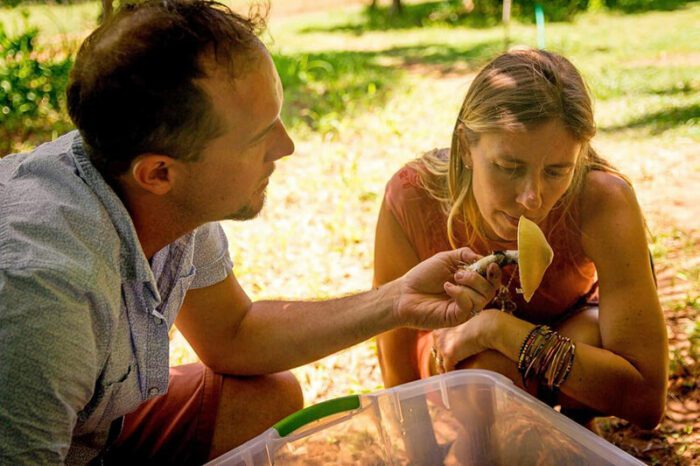
“I want to make sure that people are able to have a powerful enough experience that it is transformative but at the same time I want to make sure that things don’t get too out of hand. One of the things that is an element of that is continuing to work with people who I have worked with over a long period of time, so knowing how individuals respond individually.
For those I’m new to working with, I just take it a little slow and help them understand that even if they don’t have a massive experience, they still are going to get an enormous amount of benefit out of it, especially with the coaching and if they are willing to put in the work to really explore what they came across. Personally, one of the realizations that I’ve come to in the last several years is that bigger is not always better when it comes to working with the mushroom.”
“More than Integration (MTI) is basically considered an extension of the Psanctuary ministry and MTI is that coaching program that is a part of the sacramental services. So when people sign up for a weekend with us, that’s actually what, aside from the lodging, accommodations, and food, that is what they are paying for: the coaching program.
That arose out of my experience in Jamaica because we had onsite integration and follow up integration afterwards but I never really felt like this kind of typical integration where you just kind of recall your experiences and try to understand what your experiences meant, I never really felt like that was enough. I still don’t. I feel like what people really need is an ongoing community. I am still very much integrating my first experience when I was 19 years old.
So to put together an intentional community that provides support, provides tools, provides ongoing, continuing education opportunities for people to gain more insight into their experiences as they have additional openings of their heart and mind is really what the name is trying to imply. Psychedelic growth requires more than just this standard concept of integration. It really requires a lifestyle change, an immersion in a community that can support you for years if need be.”

“We’ve got people from Norway coming in, we’ve got people from Jamaica that I’ve worked with down there, we’ve got people from the UK already coming into this on the zoom calls. It’s really exciting to just see this building as a community of support and shared perspective.
I think there’s a lot of people out there who are, while everybody respects the clinical and research models that are ongoing and all of that, but there are a whole lot of people out there that really look at this from a much more personal perspective. It’s not just a medicine. This is not just a science-based experience. This is something we cannot put words to. This is a mystical experience and the science supports that the mystical experience, the mystical aspect of the psilocybin experience, is elemental to the healing that comes out of it.”
“We are actually only 19 weeks into our organization’s official start so considering we’re only 19 weeks in, we’ve already got 100+ members, I feel like we are doing pretty good. I am a pretty ambitious person though so I want some of these other projects in place ASAP. There’s a whole lot more that we have planned but right now we are just trying to really lay a solid groundwork.
The Sunday services are excellent at building that community and spreading the community out. I am very hopeful that in time Psanctuary will have locations around the country, possibly in other countries, who knows? And the Sunday calls are a great way to get that ball rolling and build the little smaller communities here and there. It’s hard for things to move as fast as I would like them to but when I actually take a step back and look at it, we’re doing pretty good for where we are considering that there’s only three of us that are really running the organization.”
"We trust the medicine. We trust the sacrament. We trust the primacy and intelligence of the mushroom and the best thing that we can do usually is to stay the f**k out of the way.”
Eric Osborne
“Absolutely, 100%. We trust the medicine. We trust the sacrament. We trust the primacy and intelligence of the mushroom and the best thing that we can do usually is to stay the f**k out of the way.”
“Personally, it allows me to feel more comfortable expressing my authentic relationship with the mushroom. This allows me to really from the start, as someone who has been working with mushrooms for 23 years, allows me from the first time I sit down with somebody, to talk with them in the most authentic way possible. That’s the only aspect of inauthenticity that I ever felt I brought into the space in Jamaica. It just became apparent that I could no longer strictly work in what I consider still to be a pretty dry and even kind of egotistical manner.
I love the science. Science is what got me into mushrooms. But it only goes so far. And I feel like both typical religion and typical science have this very egotistical ‘we know the answer’ kind of perspective and I call bullshit. We don’t know. And that’s the perspective that I always try to take from the beginning when I’m working with somebody is that I don’t know what’s going on. I don’t know. I am doing my best to try to put the pieces together just like you. I get new information all the time that maybe gives me a broader perspective. But the truth is we’re never going to fully know what’s going on with reality and the human experience while we are in this limited physical capacity.”

“There are two elements to assuring harm reduction outside of the dosing and setting and the mindset going into it. One is to stay out of the way of the mushroom. Once you start to interfere with someone’s experience, and I don’t think enough practitioners really understand this and I think particularly in the clinical setting it’s not really understood well enough, but once you start to interfere or interject yourself into someone else’s experience, you are introducing variables that can bring about outcomes that you are not ready to deal with.
The other crucial element that I truly believe is the most important aspect of harm reduction when you are working with people under the influence of psychedelics is your own personal level of experience. If people know that you are inauthentic, that you are insincere, that you are not there for them, but you are there to somehow boost your own ego or to try to play hero, that will be known. I have seen it cause serious upset and I have seen facilitators who put their intentions and their ego before the people that they are working with, or who came to the space with a lot of their own very dark stuff that they had not worked through. That will cause some real problems. If you have somebody who is on a large dose of psilocybin and they are freaking out, if you tell that they are going to be okay but you don’t trust that they are going to be okay, they are going to know that and it is going to escalate the situation so much more rapidly.
The subtleties that go into this space, the subtleties that contribute to safety are not talked about enough. There’s a lot of talk about eyeshades and music and methods of control but in my experience, my sincere belief is that the most effective safeguard that we can bring into this space is our own authenticity and our own ability to look at our shit, to have real tough experiences with the mushroom so that people know that they are working with someone who…maybe I’ve never experienced what you are experiencing per se, but I have died a thousand times on mushrooms, I’ve had at least 500 doses of psilocybin myself and so many of those have been just excruciating. So people know when you look at them and you say to them ‘I get it.’ When they are in that state of high perception and real vulnerability, they know if you are telling the truth or if you are just bullshitting them and if you are bullshitting them it’s going to set off so many alarms.”

“I could say that it’s about the healing of the individual but what I have really learned from working with the mushroom is that whenever one of us sets on a healing path, whenever one of us experiences some kind of exponential growth, we are not figuratively, we are literally doing that for the collective of humanity.
I have worked with some very challenging situations and most of those people were just regular folks who had been building up a lifetime of unprocessed trauma. It just really is important to me that people know that they are supported, they know that we are here to be of service to them so that they can grow and be the best that they can be so when they go back to their homes and their communities, they can take that there and help their communities be better.”
I have seen processing take place that provided relief for people seemingly completely unassociated with the event. I know that it sounds flaky to a lot of people but I know that beyond a doubt that every time somebody eats mushrooms in a safe, cared for manner where healing is allowed to occur, that they are helping to heal every human being on this planet. We truly are one. That is not a metaphor.”
“Success looks like a growing community of compassion and authenticity. It’s pretty simple. They [psilocybin mushrooms] are a tool for processing but as we process this kind of stagnant information, then we become more authentic and if there is anything that will really help to heal humanity, it’s if we put down all these fucking masks, and all this bullshit baggage of ‘I’m this group’ or ‘I’m this person’ and we just really get back to the basics that we are just humans and we don’t even know what that is. Through that we can learn to love each other and love the moment a little bit more and the closer we get to that, that’s what I call success. Success is not an end result. Success is an ongoing effort.”
“It’s really important to advise caution. It can look a lot simpler than it is. I know there are a lot of people who are thinking ‘Maybe I should start a church.’ I’m not saying that you shouldn’t but I’m not saying you should. People don’t see the 23 years of experience that has gone into this thing right here right now and that is really important to consider because this is not a fucking play thing. I also just really want to make sure people are smart for their own safety and for the ongoing growth of this work so that more people can get access to the healing of these mushrooms.”
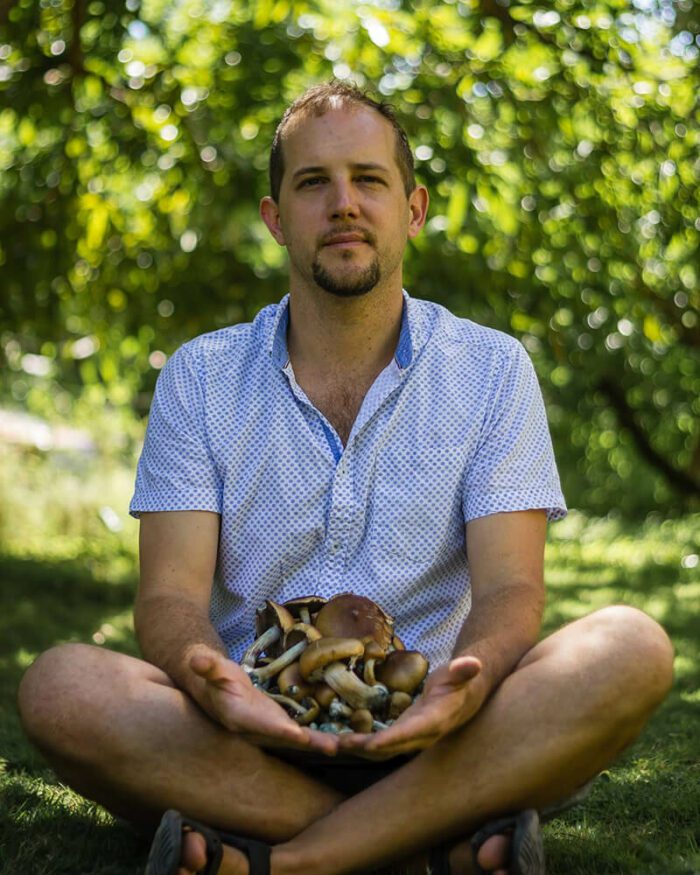
Sam is a writer, award-winning journalist and professional mycologist from the United States who arrived at the Fungi Academy one midsummer’s day in 2019 and left six weeks later with lifelong friends and a passion for mushroom cultivation.
In the past year three years, he’s built a laboratory and fruiting room in his home, cultivated and foraged over 20 species of gourmet and medicinal mushrooms, started a medicinal mushroom tincture business and returned to the Fungi Academy to teach his techniques to students.