
Quick answer: A mushroom tincture is a concentrated liquid extract made by soaking dried medicinal mushrooms in alcohol and water. Mushrooms hold two different families of beneficial compounds — alcohol-soluble triterpenes and water-soluble beta-glucans — so the best method is a double extraction: an alcohol soak plus a hot-water simmer, combined into one bottle. Start to finish takes roughly 4–8 weeks, and the result keeps for years.
Let’s talk about mushroom tinctures.
It’s honestly one of my favourite ways to work with the Fungi. Growing mushrooms is epic, eating them is epic — but there’s something about taking a tough, woody, completely inedible mushroom like reishi and coaxing its medicine out into a little amber bottle that feels like a kind of alchemy. You can’t chew a reishi. Your body can’t break down that hard, chitinous fruiting body on its own. But with a bit of alcohol, a bit of water, and a bit of patience, you can unlock everything it has to offer.
I’ve been making tinctures here at Fungi Academy HQ in Tzununá for years now, and I want to walk you through the whole process — properly, the way we actually do it. This is the double extraction method, and once you understand why it works, you’ll never forget it.
What is a mushroom tincture?
A tincture is just a concentrated extract of a plant or mushroom suspended in a solvent — usually alcohol. You take your mushroom, you soak it in a solvent that pulls the good stuff out, you strain off the solids, and you’re left with a potent liquid you can dose by the dropper.
The reason tinctures matter so much for mushrooms specifically comes down to one stubborn fact: your gut can’t digest raw mushroom. Medicinal mushroom compounds are locked inside cell walls made of chitin — the same tough material as an insect’s exoskeleton. Eat a dried reishi and most of it sails straight through you. Extraction is how you get past that wall and actually make the medicine bioavailable.
Why a double extraction?
This is the part I get nerdy about, so bear with me — it’s the single most important thing to understand.
Medicinal mushrooms carry two completely different families of beneficial compounds, and they don’t dissolve in the same thing:
Triterpenes — things like the ganoderic acids in reishi — are the bitter, anti-inflammatory, liver-supporting compounds. They are alcohol-soluble. Water will never touch them.
Beta-glucans and other polysaccharides — the big immune-modulating compounds the mushroom world is famous for — are water-soluble. Alcohol will never touch them.
So here’s the problem: if you only do an alcohol tincture, you get the triterpenes and miss all the beta-glucans. If you only do a hot water extract (basically a long mushroom tea), you get the beta-glucans and miss all the triterpenes. Either way you’re throwing half the mushroom away.
The double extraction solves it. You run both processes — an alcohol soak and a hot-water simmer — and then marry them into one bottle. Nothing wasted. The full spectrum of the mushroom, in one dropper. It’s such an elegant solution and the Fungi basically forced us to figure it out. I love that.
🎥 Prefer to watch?
Our full video walkthrough of the double extraction process goes right here.
What you’ll need
Nothing fancy. This is kitchen-table stuff:
Dried medicinal mushrooms. Reishi, chaga, turkey tail, lion’s mane, cordyceps — all great. They must be dried, not fresh (more on why below). Whole or roughly chopped is fine; a coarse grind is even better.
High-proof alcohol. A decent vodka at 40% (80 proof) works perfectly well. If you can get something higher-proof, even better — the more alcohol, the harder it pulls those triterpenes. You can always dilute high-proof spirit down with water later.
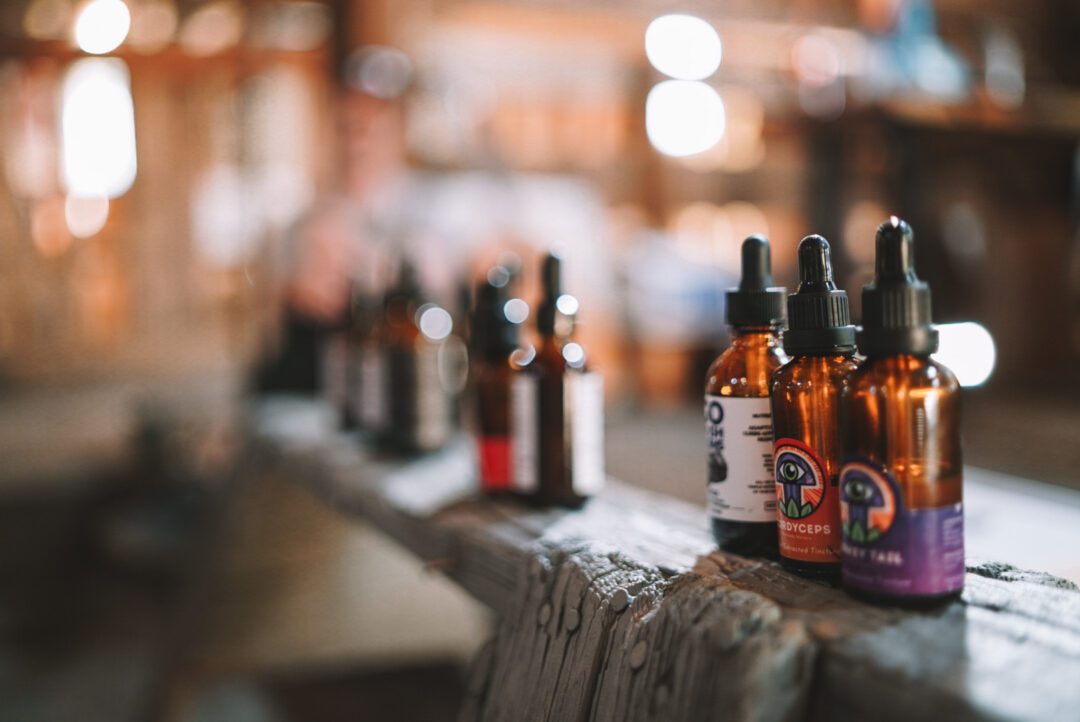
A glass jar with a tight lid for the alcohol soak, a pot for the water simmer, a fine strainer or cheesecloth, a measuring scale, and amber dropper bottles to store the finished tincture.
That’s it. If you’ve ever made a salad dressing you have everything you need.
How to make a double-extracted mushroom tincture, step by step
The whole thing runs on a simple ratio. I work at roughly 1:5 — one part dried mushroom by weight to five parts liquid by volume. So 100g of dried reishi to 500ml of liquid. Easy to scale up or down.
Step 1 — The alcohol extraction
Put your dried, chopped mushroom into a clean glass jar and pour your alcohol over it until everything is fully submerged. Seal it tight.
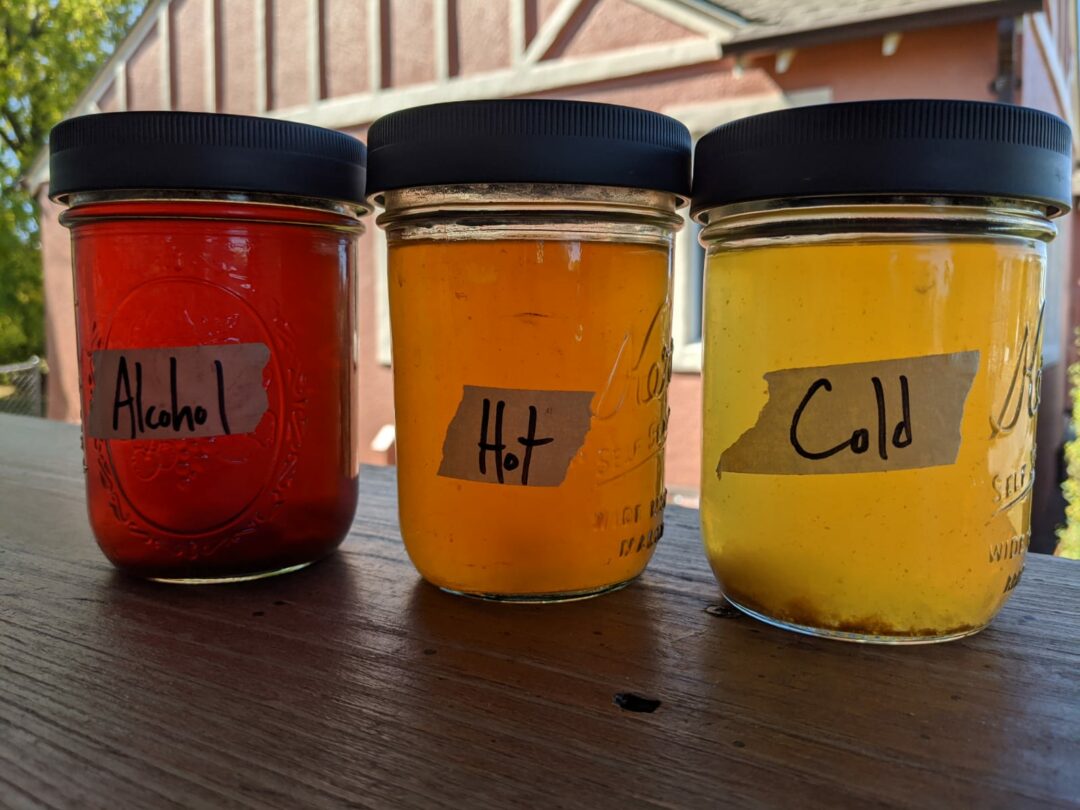
Now it sits. Keep the jar somewhere cool and dark and let it steep for four to eight weeks. Give it a good shake whenever you walk past it — once a day if you remember, once a week if you don’t, the Fungi are forgiving. Over those weeks the alcohol slowly draws the triterpenes out and the liquid turns a deep amber-brown.
When the time’s up, strain the liquid off through cheesecloth. Here’s the key bit people miss: don’t throw the mushroom material away. Squeeze it out and keep it. Set your strained alcohol extract aside in a sealed jar — it’s done and waiting. The leftover mushroom still has all its beta-glucans locked inside, and that’s what Step 2 is for.
Step 2 — The water extraction
Take that leftover mushroom material and put it in a pot. Cover it with water — and add a little extra, because you’re going to cook a lot of it off.
Bring it to a gentle simmer — and I mean a real simmer, not a rolling boil. Low and slow. Let it go for several hours, somewhere in the two-to-eight hour range, topping up the water a little if it gets too low early on. You’re slowly breaking down those chitin cell walls and pulling the beta-glucans into the water. Towards the end, let the volume reduce right down so you finish with a small, concentrated amount of dark mushroom liquid.
Strain it one more time, and let it cool down completely. Now this mushroom material really is spent — it’s given you everything. Compost it with my blessing.
Step 3 — Combine and bottle
This is the marriage. Mix your alcohol extract from Step 1 with your cooled water decoction from Step 2.
One thing to watch: your finished tincture needs to stay at at least ~25% alcohol so it’s naturally shelf-stable and won’t spoil. That’s why you reduced the water down so far in Step 2 — so it doesn’t dilute the final blend too much. If you’re unsure, lean towards more alcohol extract and less water.
Pour the combined tincture into amber dropper bottles, label them with the mushroom and the date, and you’re done. You just made medicine.
Which mushrooms make the best tinctures?
Double extraction shines with the tough, woody, polypore-type mushrooms — the ones you couldn’t eat even if you wanted to. Here are the classics:
Reishi (Ganoderma) — the queen of tincture mushrooms. Loaded with triterpenes, famously bitter, traditionally used for calm, sleep, and immune support. If you only ever tincture one mushroom, make it reishi. We’ve got a full guide to reishi if you want to go deeper, and you can even grow your own.
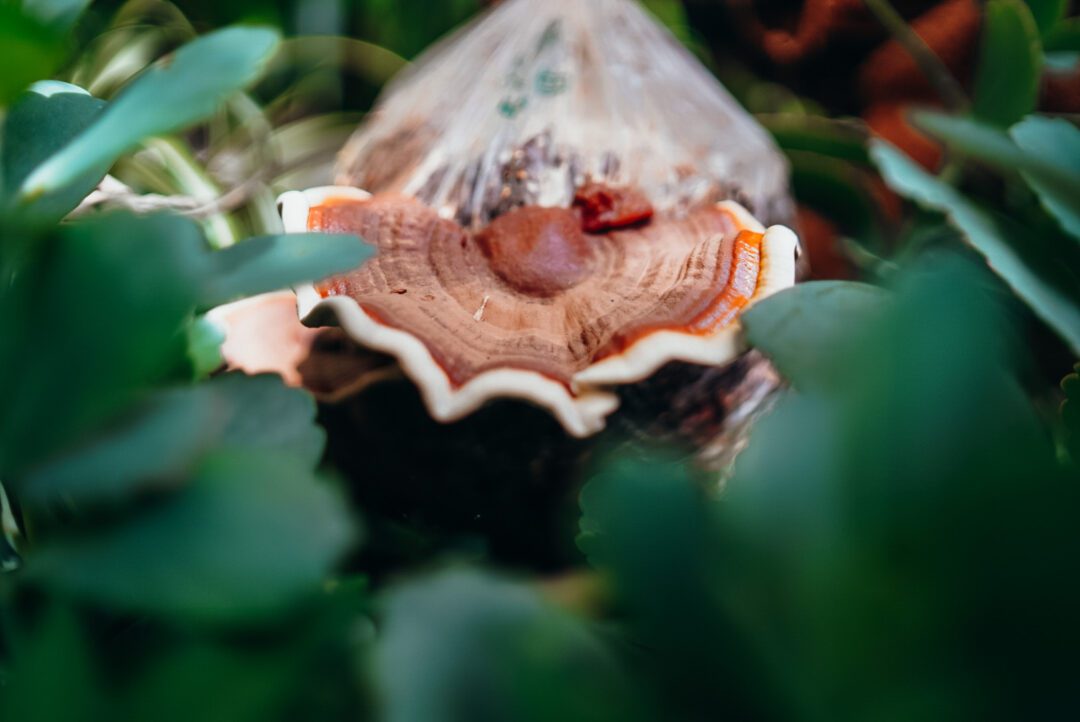
Turkey tail (Trametes versicolor) — one of the most-studied immune mushrooms on Earth, and it grows on dead wood almost everywhere. A brilliant beginner mushroom to tincture.
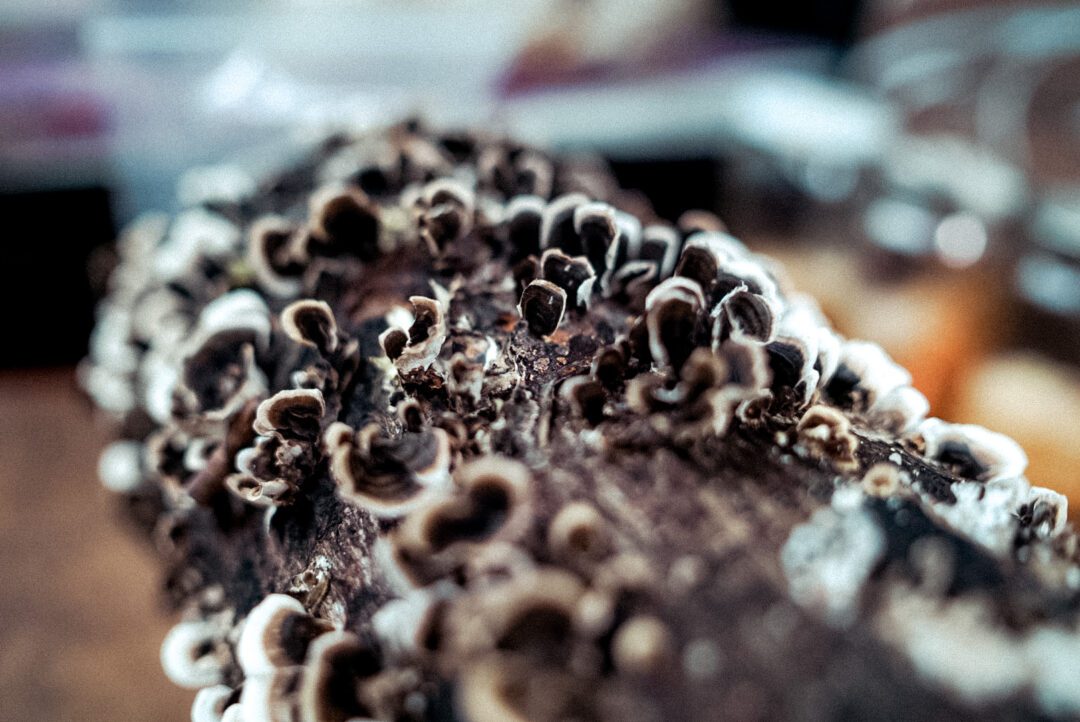
Chaga (Inonotus obliquus) — the dark, charcoal-looking growth from birch trees. Rich, earthy, antioxidant-heavy. Double extraction is essential here.
Lion’s mane (Hericium erinaceus) — yes, you can eat lion’s mane, but a double-extracted tincture concentrates its compounds beautifully for daily use. It’s the one people reach for around focus and nervous-system support. Here’s our full lion’s mane guide.
Cordyceps — the energy and stamina mushroom. Another excellent double-extraction candidate.
How to take a mushroom tincture
Simple. A dropperful — roughly a millilitre — once or a few times a day, either straight under the tongue or stirred into water, tea, or coffee. Some people do a single morning dose, some spread it through the day. Start low, see how you feel, adjust from there.
Tinctures are a daily-ritual kind of medicine, not a one-off. The benefit comes from showing up consistently — which, honestly, is true of most good things. If you’d rather buy than brew while you learn, our buyer’s guide to mushroom supplements will help you spot a quality product.
A note on psilocybin tinctures
People always ask, so let’s be clear-eyed about it. Yes — psilocybin mushrooms can be made into a tincture, and it’s essentially just the alcohol step: dried mushrooms steeped in high-proof alcohol, then strained.
But two important differences. First, you would never apply heat or a water decoction to psilocybin mushrooms — heat degrades psilocybin, so the long hot simmer that’s perfect for reishi would wreck a psilocybin extract. If a cold, no-heat preparation is what you are after, that is exactly what lemon tek does, soaking dried mushrooms in citrus instead of cooking them. Second, the legality of psilocybin varies enormously by country and region and is changing fast, so check your local laws before doing anything. We share this for education only. If your interest is in the psilocybin side of things, start with our guide on how to grow magic mushrooms.
How to store your mushroom tincture
Tinctures are wonderfully low-maintenance. Keep them in amber glass — light is the enemy — somewhere cool and out of direct sun. As long as your finished tincture sits at 25% alcohol or higher, it’s self-preserving and will easily keep for several years. The alcohol does all the work. No fridge needed.
Common mistakes to avoid
Using fresh mushrooms instead of dried. Fresh mushrooms are mostly water, and that water dilutes your alcohol below the strength it needs to extract and preserve properly. Always dry first.
Boiling the water extraction instead of simmering. A hard boil is too aggressive. Low and slow pulls the beta-glucans without damaging them.
Rushing the alcohol soak. Two weeks is a bare minimum; four to eight is where the real depth comes from. Patience is the ingredient nobody lists.
Ending up too low on alcohol. If the final blend drops below ~25% alcohol it can spoil. Reduce your water decoction down properly so it doesn’t water everything down.
Using mycelium-on-grain instead of fruiting bodies. Whole dried fruiting bodies carry far more of the active compounds. Start there.
Frequently Asked Questions
How long does it take to make a mushroom tincture?
Plan on four to eight weeks. The alcohol soak is the long part; the water simmer and combining take a single afternoon.
Can I use fresh mushrooms?
No — use dried. Fresh mushrooms are too high in water, which dilutes your alcohol and undermines both the extraction and the shelf life.
What alcohol is best for mushroom tinctures?
A 40% (80 proof) vodka works well. Higher-proof spirit extracts triterpenes more effectively and can be diluted with water afterwards.
Why do you need both alcohol and water?
Because mushrooms hold two kinds of beneficial compounds: alcohol-soluble triterpenes and water-soluble beta-glucans. A double extraction captures both — a single solvent only gets half.
How long does a finished tincture last?
Kept in amber glass somewhere cool and dark, a tincture at 25%+ alcohol will keep for several years.
Which mushroom should a beginner start with?
Reishi or turkey tail. Both double-extract beautifully and are forgiving of small mistakes.
Ready to go deeper?
Making your own medicine is one of the most quietly satisfying things you can do — it connects you to the Fungi in a way buying a bottle never quite will. If you want to learn the whole craft properly, from growing your own mushrooms to extracts and beyond, our Online Mushroom Cultivation Course takes you from total beginner to confident grower, and our piece on herbal allies for homemade mushroom medicine is a lovely next step. For the more advanced extraction rabbit hole, take a look at our write-up on the Soxhlet extractor.
Go make something. The Fungi are waiting.
This article is for educational purposes and is not medical advice. These statements have not been evaluated by the FDA. Mushroom products are not intended to diagnose, treat, cure, or prevent any disease. Consult a healthcare professional before use.