
Quick answer: Agar is a gelatine-like growth medium poured into petri dishes and used to start, purify, and clone mushroom cultures. Because you can actually see the mycelium spreading across the dish, agar lets you isolate clean, vigorous growth — and catch contamination early, before it ever reaches your grain.
Agar is where you actually get to meet the Fungi.
Most of cultivation happens in the dark — inside jars, inside tubs, mycelium doing its thing where you can’t watch. Agar is different. On a clear petri dish you can see exactly what your culture is doing: how fast it runs, what colour and texture it is, whether something else snuck in. It’s the closest thing a home grower has to a microscope, and honestly, once it clicks, it changes how you grow.
I’ll be honest — I put off learning agar for way too long. It looked like the technical, lab-coat part of growing, the bit reserved for serious mycologists, not me. Then I finally poured my first plates and kicked myself for waiting. It isn’t hard. It’s just careful.
What is agar?
Agar is a nutrient-rich jelly. You take a gelling agent — agar-agar, derived from seaweed — mix it with water and a food source for the mycelium, sterilise it, and pour it into petri dishes where it sets into a smooth surface. Mushroom mycelium then grows across that surface where you can watch every millimetre of it.
Why bother with agar?
Because agar is your quality-control step. It lets you purify a messy culture, clone a mushroom you love, isolate the fastest, healthiest strain from a batch, and spot contamination while it’s still a tiny speck instead of a ruined jar. Skip agar and you’re growing blind. Work with agar and you’re making decisions.
Free Beginner’s Guide
Grow your first mushrooms — for free
Get the free guide that walks new growers through the whole path — plus 5 free videos to send you on your way.
- The exact gear you need — and the pricey stuff you don’t
- Where to source spores & cultures without getting scammed
- How to spot and beat contamination before it wipes out your grow
What you’ll need
A gelling recipe — agar-agar powder plus a nutrient source, with light malt extract being the classic choice (malt extract agar). Petri dishes, a pressure cooker to sterilise, a still air box to work clean in, a scalpel or blade, and isopropyl alcohol for sterilising your tools. That’s the whole kit.
How to pour agar plates
Mix your agar recipe with water, pour it into a jar, and pressure-sterilise it for 30–40 minutes. Let it cool until it’s still liquid but no longer scalding, then — inside your still air box — pour a thin layer into each petri dish and let it set. Pour cleanly and don’t breathe over your plates.
Working on agar
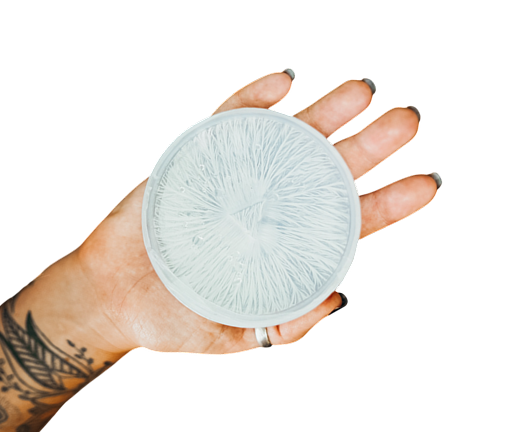
Spores to agar: streak a spore syringe across a fresh plate, or drop a spore print onto it, and watch what germinates.
Cloning: take a tiny piece of clean inner tissue from a fresh, healthy mushroom and place it on agar — the mycelium will grow out, a genetic copy of that exact mushroom.
Agar-to-agar transfers: this is the purifying move. Cut a small wedge from the clean, fast-growing leading edge of your mycelium and move it to a fresh plate. Repeat once or twice and you’ve isolated pure, vigorous growth.
Reading your plates
Healthy mushroom mycelium is bright white and grows evenly — sometimes wispy, sometimes ropey. Anything green, black, pink, grey, or wet and slimy is contamination. Don’t try to rescue it. Bin it and move on. Learning to read a plate at a glance is one of the most valuable skills a cultivator builds.
From agar to grain
Once you’ve got a clean, healthy plate, cut a wedge and lay it on a jar of sterilised grain to make your grain spawn. From a single good plate you can start many jars.
Frequently asked questions
No, you can grow without it. But agar massively improves your success rate by letting you start every grow from clean, proven culture.
Light malt extract agar, or a pre-made mix if you’d rather skip measuring.
Any colour that isn’t white, such as green, black, pink, or grey, or a wet, slimy texture. Healthy mycelium is white and even.
Go deeper
Agar work is the backbone of clean, reliable cultivation — it’s the deepest module in our Online Mushroom Cultivation Course, with every pour and transfer shown on video. And our full guide to growing magic mushrooms shows where agar fits in the bigger cycle. Take your time with this one — the Fungi reward patience.