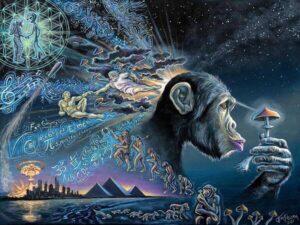
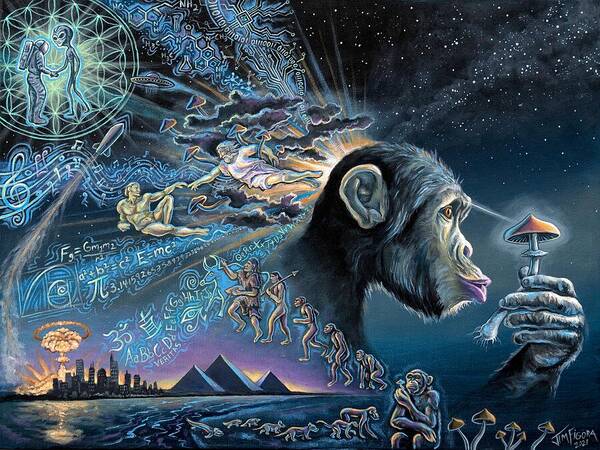
The short version: In his 1992 book Food of the Gods, Terence McKenna argued that psilocybin mushrooms could be the key to humanity’s massive leap in consciousness. It is a wild, hotly disputed idea, but recent findings give it a little more foothold than you might expect. Here is my personal take on the Stoned Ape Theory, the evolutionary story behind it, and why I think mushrooms may have taught us to speak.
Why are we so different from other animals? Why do we dominate the world and not our biological cousins, the bonobos, chimpanzees and gorillas? Why do we talk? Why are we naked? These are some of the big questions that have plagued great minds for eons. Some have looked for religious answers, some credit fire, meat and fish, some even claim alien intervention. But in 1992, one unique mind had a very, very different take on it all.
Terence McKenna, in his incredible book Food of the Gods, claimed that psychedelic mushrooms could be the key to our massive leap in consciousness. I have spoken briefly about this in my video with After Skool and other places around the internet, but I think it deserves an actual deep dive into my personal take on McKenna’s wild idea. One that, with recent findings, might just have a foothold in our understanding of human evolutionary biology.
Before I go deeper, I want to emphasize that I am by no means an expert in this field, and that many of the hypotheses I will cover are highly disputed by academics. But that does not make it any less fun to contemplate.
Meet our proto-human ancestors
Humans, technically Homo sapiens, are the last surviving species of our genus, Homo, which sits within the hominid family, part of the order of primates. Other hominids include gorillas, orangutans and, of course, our closest cousins, the chimpanzees and bonobos.
Our split from our last common ancestor with chimpanzees is highly disputed, ranging anywhere from 13 to 6.5 million years ago, although studies from this decade suggest it is probably closer to the more recent end. Some research even suggests we split, then started interbreeding again about a million years later. Fun stuff. Either way, it is a long time ago, and even if we take 6.5 million years as the truth, that is still a whopping 2 million years before the first proto-humans, the Australopithecus, appear.
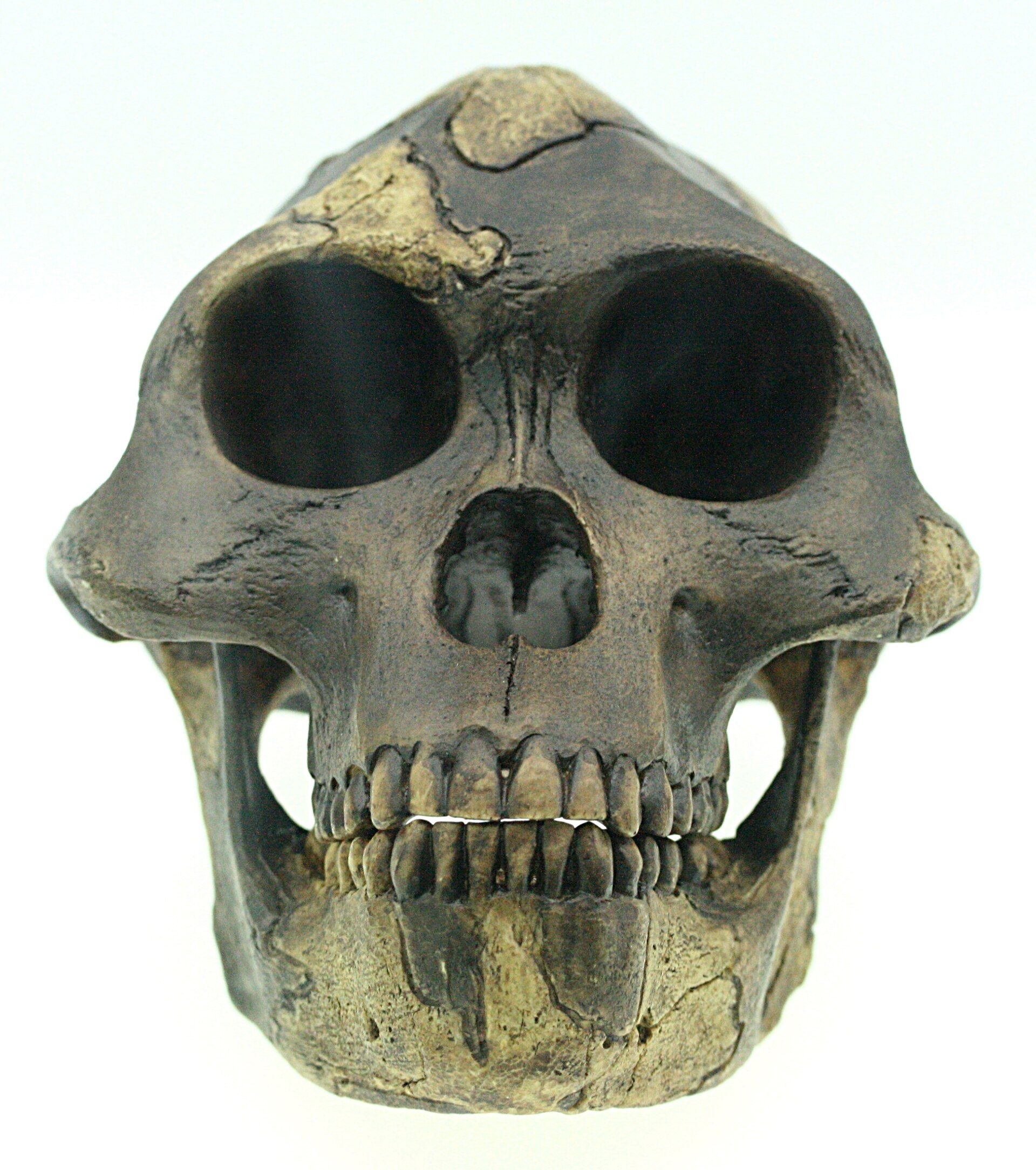
It is now widely accepted that Australopithecus were the ancestors of our genus. We used to think big brains came before walking upright, but it is now known that Australopithecus was walking on two feet a considerable amount of the time closer to their extinction about 2 million years ago. I believe they might be the perfect contender for a highly debated part of our evolution, a theory shunned by many but embraced by some incredible people, including the legendary Sir David Attenborough.
The Aquatic Ape: a watery stepping stone
The Aquatic Ape Theory proposes that during our evolutionary journey, our ancestors spent a considerable amount of time in bodies of water. It would help explain our loss of hair, our bipedalism, our dive reflex, the faint webbing between our fingers, the ease of water births, and even the thin layer of fat we carry between skin and organs.
Imagine Australopithecus, or other ancestors who never made it into the fossil record, living in nests built in trees in a swampy or coastal environment. Eating the bountiful fruits from the trees, wading through the water from tree to tree, catching fish, turtles and even crocodiles as they go. This would not contradict the modern evidence suggesting Australopithecus ate a mostly vegetarian diet supplemented by seafood. Wading through water would build the core muscles needed for an upright existence, and would select for individuals with less fur, except on top of their head.
Unlike true proponents of the Aquatic Ape Theory, who claim we walked out of these swamps as Homo habilis, I think this was more of a stepping stone. Evolve a little core strength, lose a little of that full coat of hair, maybe grow the brain a bit through an omega-3 heavier diet, and boom, you have set the stage for a savanna-adapted ape.
Onto the savanna
The core muscles came in handy for looking over tall grass. Less hair fared better in the hot, arid climate. And that slightly bigger brain was crucial for solving the puzzle of survival our ancestors faced after leaving their abundant aquatic ecosystem.
But even with all those adaptations, life on the savanna was not easy. Suddenly our ancestors faced food scarcity, drought, dangerous predators like lions, and scavengers like hyenas. It would not be a stretch to say the first generations of savanna-surviving hominids were hungry and thirsty. And yet, here we are, living and hopefully thriving. It speaks to the tenacity and adaptability of our ancestors.
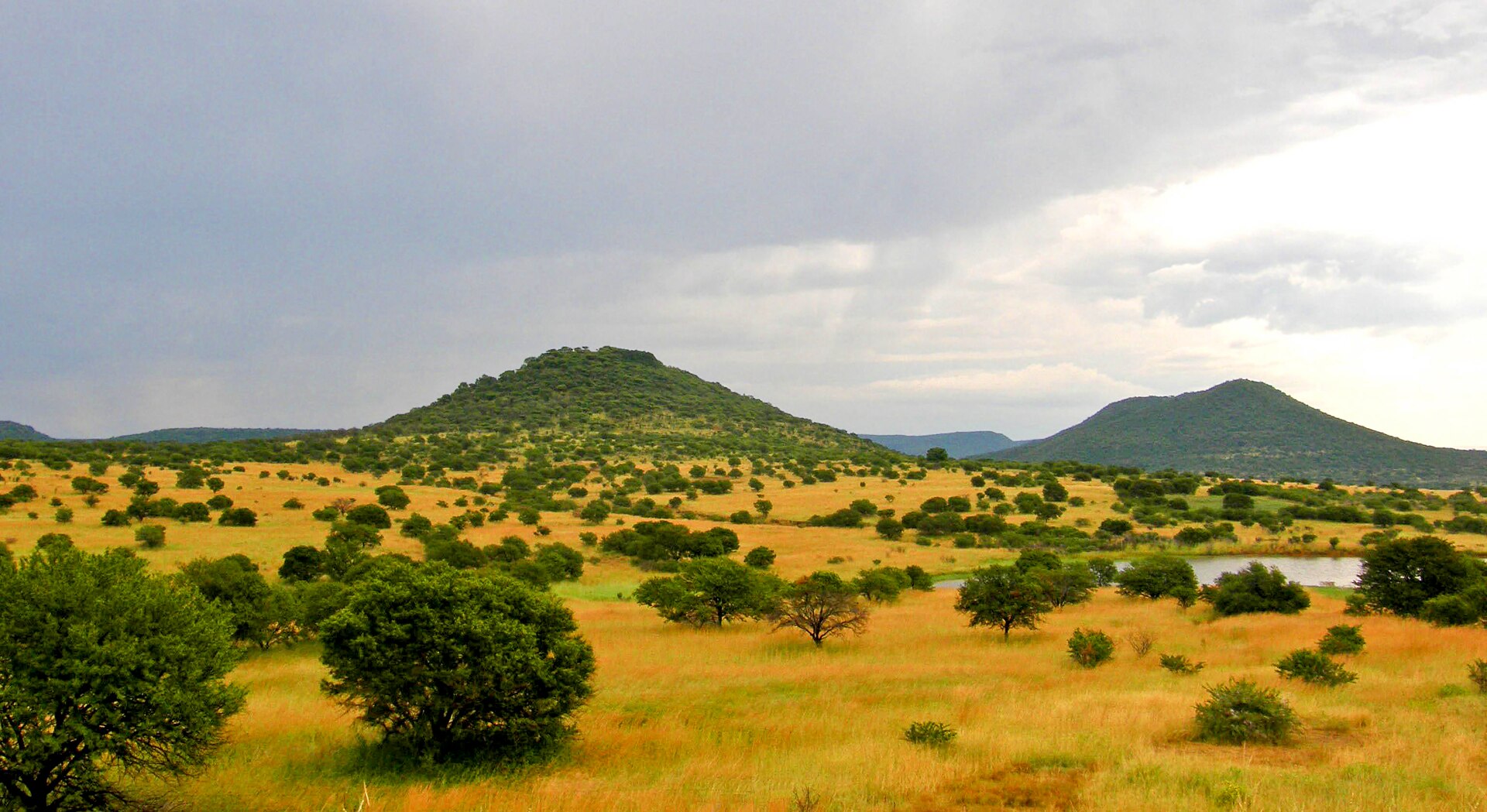
So how did they survive? What were they eating, now that they no longer had their abundance of fruit and fish? Most likely these early savanna apes roamed the plains in search of the few fruit trees that made their home in the dry grass. These trees were a place to nest at night and, in the perfect scenario, a source of food. But what would you do if you found a tree that had already dropped most of its fruit? If you were hungry and thirsty enough, you would probably eat whatever you could get your hands on, even spoiled fruit from the savanna floor.
Spoiled fruit, alcohol, and the ADH4 gene
Spoiled fruit is simply food that is already being consumed by something else: microorganisms. And while larger creatures like animals can physically fight over food, these tiny microbes have to wage chemical warfare to defend their share of those sweet sugars. This ancient battleground pushed both fungi and bacteria to produce some incredible chemicals, including penicillin, the first antibiotic.
And alcohol. Yes, you read that right: alcohol is the biochemical superweapon of a single-celled fungus we know as yeast. Yeast is incredibly good at securing the sugars in an ecosystem while keeping competing bacteria out of its food. But alcohol also has the side effect of seriously messing up the larger beings in the ecosystem, potentially removing the individuals who overindulge on the forbidden fruit from the gene pool.
Yet somehow our ancestors adapted to eating these boozy fruits. Most primates carry a mutated ADH4 (alcohol dehydrogenase 4) gene that lets us process this fungal bioweapon more efficiently. In other words, we can pull more calories from fermented fruit without getting so wasted that we try to become best friends with a lion. A very useful trait when you are surviving in an environment that offers scraps compared to what you are used to.
Over millions of years our ancestors adapted, biting tooth and nail for every calorie the ecosystem had to offer. Our upright posture became ideal for covering large distances while keeping our calorie output low. Our bodies lost even more hair as we became some of the sweatiest animals on the planet. Most likely this led our ancestors to follow herds of large herbivores, scavenging the old, sick or injured, and perhaps even practicing a form of persistence hunting: running an animal down until it gives up from exhaustion.
Following the herds, and their droppings
During these times of scarcity and rapid change, our ancestors started using tools, and by the time Homo habilis showed up we were probably speaking some form of simple language. Was this the result of our change in lifestyle and diet? Or was something else in play?
Remember, during this time our ancestors needed to optimize their calorie intake per square meter. And if they spent a lot of time following large herbivores, they would have run into their dung. Almost all primates have been seen going through dung looking for food. Chimpanzees, our closest living relative, are even known for picking through their own droppings for undigested seeds. Yum.
But 2 million years ago, on the eastern African savanna, during the wettest times of the year, those droppings held a different kind of treasure for our ancestors.
Enter the Psilocybe mushroom
Psilocybe mushrooms.
The genus Psilocybe arose in Africa about 67 million years ago, with active alkaloid synthesis appearing somewhere between 40 and 9 million years ago. The evolutionary advantage of psilocybin synthesis is highly speculated. For a long time the leading thought was that it acted as an animal deterrent, but these mushrooms appear so infrequently that it is unlikely animals would learn to recognize them. In all honesty, we just do not know.
What we do know is that our Australopithecus ancestors were in for a wild ride when they ate them.
McKenna’s Stoned Ape Theory
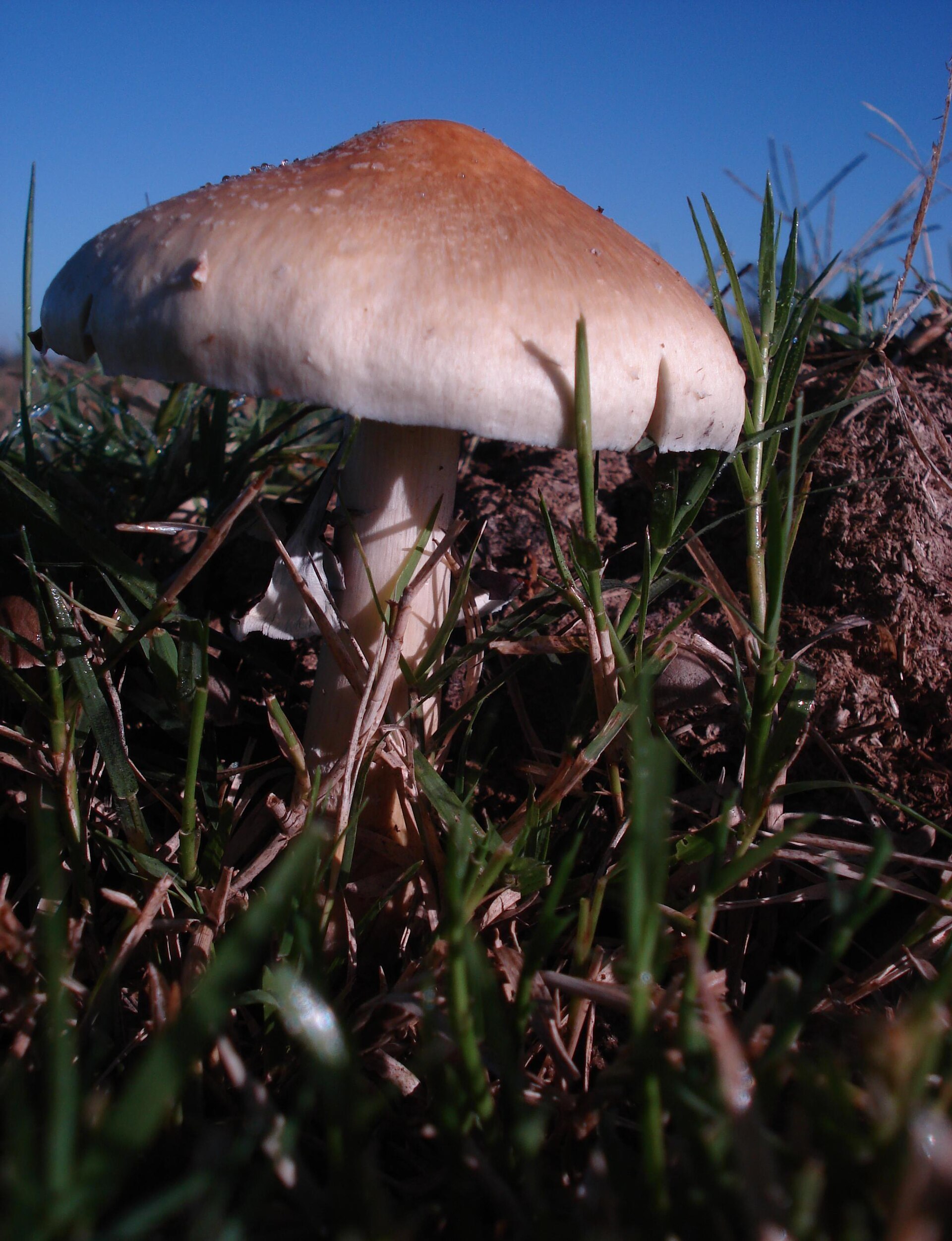
In Food of the Gods, McKenna claimed that eating Psilocybe mushrooms growing from dung led to the cognitive revolution. Let me walk through the most important parts of his theory so we are on the same page.
He believed consuming Psilocybe cubensis presented an evolutionary advantage. Low doses, he argued, would improve visual acuity and therefore create better hunters. At higher doses, McKenna contended the mushrooms would increase libido, attention and energy, resulting in greater reproductive success. At even higher doses, the psilocybin would promote social bonding within early human communities, as well as group sexual activity, resulting in greater genetic diversity from the mixing of genes.
Mushroom-fueled ape orgies. You have got to give him an A for creativity. But even though that sounds like a lot of fun, I personally do not find mushrooms to be a strong aphrodisiac, and I do not know many people still in McKenna’s camp on this one. Moving on.
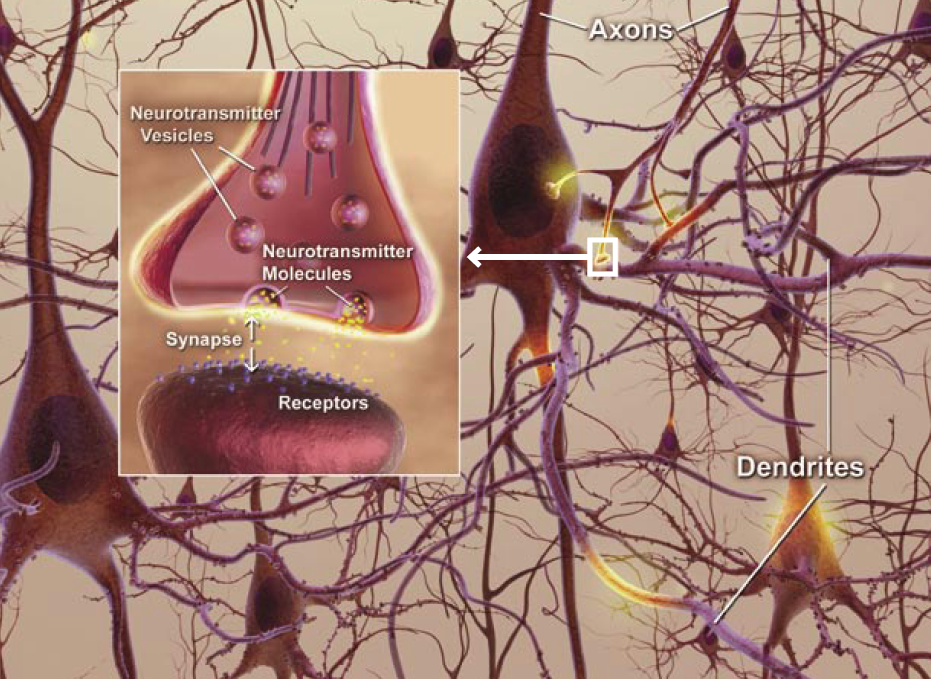
His contemporaries, like Paul Stamets, are keener to talk about epigenetic neurogenesis. Besides sounding really cool and smart, epigenetics is a legitimate field focused on how behavior and environment can change our genes before we pass them on. Neurogenesis is the process by which new neurons are generated in the brain. Some studies suggest Psilocybe mushrooms have neurogenic properties, meaning consuming them might help your brain produce new neurons. So, as Paul says, if our ancestors consumed these mushrooms millions of times over millions of years, we could explain the rapid development of human cognition through epigenetic neurogenesis.
Compelling and undeniably persuasive. But I think there is a better story to tell.
My take: mushrooms taught us language
I think mushrooms taught us to speak.
I know, I know, bold statement. Let me bring it to you a little more nuanced.
When psilocin crosses the blood-brain barrier, it does many things, including turning down our control center, also known as the default mode network. The default mode network is the translator between all of our senses. Our vision, hearing, smell and everything else gets filtered through it to create our perception of the world. When that quiets down, things get weird. The brain rewires itself, and parts that are normally disconnected suddenly connect. This is when synesthesia happens, the blending of the senses. Suddenly our Australopithecus ancestors could taste colors, hear the trees, and see sounds. That last one might just be the key to this puzzle.
Think of any proto-human sound. You probably land on either ooh or ahh. Let us take ooh. You are a hominid tripping on mushrooms you just ate, and while vocalizing this ooh sound, your mind suddenly projects an image of the animal you are trying to hunt. Repeat that a few dozen times and, boom, you have a kind of proto-language. Continue it down the generations and you have a tool: a way to communicate, to pass knowledge to the next generation. This is when we see consistent tool-making appear, and by the time the first true Homo shows up, even the control of fire.
Homo erectus, Neanderthals, and the rise of complex language
Homo erectus did many things: tamed fire, left Africa, perfected certain tools, and much more. So why did the true skyrocketing of our potential not happen during the 2 million years Homo erectus was around? Possibly because of their increased ability to survive. Their shift to a more carnivorous diet may have meant they did not take as many chances eating wild mushrooms. If there is no urgency, there is no need for evolution. A big brain takes up a lot of energy, and if you are cruising along just fine, there is no need to invest in a big, bulky brain, which comes with plenty of complications.
There was another factor too. The vocal cords and other verbal features of Homo erectus never evolved in a way that could produce a language as complex as ours. Did that limit our ancestors’ evolutionary potential?
Who knows. But what we do know is that when our planet went through intense climate change around 800,000 years ago, our brain size started growing again. Fast. By the time Homo neanderthalensis shows up, with a big brain and a complex vocal structure, about 500,000 years ago, we are seeing the first true, complex language on the planet.
Homo sapiens and the power of words
Whoever you are reading this, whatever your preferences, I am fairly sure you feel drawn to people who are funny, who are good at communicating their emotions, who can share words that inspire you. The individuals with a better grasp of language were more desirable mates, and they could pass their genes, and their command of language, to the next generation. If our ancestors were still eating mushrooms at this point, perhaps using that sweet synesthesia to invent new words and new complexity, well, we can never say for certain. But humans all over the world love to change our consciousness. We have done it since we started eating alcoholic fruits, and probably long before.
When our species, Homo sapiens, finally appears around 300,000 years ago, we shared the world with Homo neanderthalensis and many other species of our genus. What set us apart was our ability to live harmoniously in large groups. To thrive in a big group, you need strong, kind, inspiring leadership and the ability to resolve conflict. A mastery of language is crucial to holding a group together, and perhaps the mushrooms guided our ancestors along the way.
I do not know if mushrooms make nicer people. I would like to believe these experiences can make some of us more kind and generous. I do not know if handing these ancient allies to world leadership would make the world a better place, but whatever we are doing now clearly is not working. So why not give it a shot?
Grow your own allies
Learn to grow mushrooms from scratch
Our Online Mushroom Cultivation Course takes you all the way from spore to harvest, no lab required. Join thousands of growers around the world.
Frequently asked questions
What is the Stoned Ape Theory?
It is the idea, put forward by Terence McKenna, that early humans who ate psilocybin mushrooms gained cognitive advantages that helped drive the rapid evolution of human consciousness, language and culture.
Who came up with the Stoned Ape Theory?
The ethnobotanist and author Terence McKenna laid it out in his 1992 book Food of the Gods. Later thinkers like Paul Stamets have built on it with ideas around neurogenesis.
Is the Stoned Ape Theory proven?
No. It is a speculative hypothesis that most academics dispute, mainly because hard evidence from millions of years ago is almost impossible to find. It is best treated as a fascinating thought experiment rather than settled science.
Did mushrooms really give humans language?
We cannot know for sure. My own twist on the theory is that psilocybin quiets the default mode network and can blend the senses, so a tripping ancestor might have paired a sound with a vivid mental image. Repeated over generations, that pairing could have seeded the beginnings of language. It is a story I find compelling, not a proven fact.
Keep exploring
If this sparked something, you might enjoy my pick of five psychedelic books worth reading (McKenna’s Food of the Gods is on the list), our full guide to microdosing, the emerging research in sacred mushrooms and mental illness, and a reflection on how magic mushrooms and nature heal both us and the planet.
This article is for educational and entertainment purposes and explores a speculative, widely debated hypothesis. It is not scientific, medical, or legal advice. Psilocybin mushrooms are controlled substances in many countries. Fungi Academy does not encourage illegal activity.
Image credits via Wikimedia Commons (Creative Commons licensed): Psilocybe cubensis, Australopithecus afarensis reconstruction, African savanna, Psilocybe cubensis, neurons and synapses.