
Quick answer: Turkey tail (Trametes versicolor) is a colourful bracket fungus that grows on dead hardwood all over the world. It’s one of the most-researched immune-supporting medicinal mushrooms — used as a tea or a double-extracted tincture, never eaten whole, because the fruiting body is far too tough and leathery to chew.
You’ve almost certainly already walked past turkey tail.
It’s one of the most common mushrooms on the planet — those little fan-shaped brackets fanning out across a fallen log, banded in rings of brown, tan, blue-grey and rust. Most people step right over it. But this unassuming little fungus is one of the most studied medicinal mushrooms we know of, and honestly, it’s one of my favourites to point out on a walk.
What is turkey tail?
Turkey tail is Trametes versicolor — “versicolor” meaning many-coloured, because no two are quite the same. It’s a saprophytic fungus, meaning it feeds on dead wood, quietly doing the essential work of breaking fallen hardwood back down into soil. It’s a recycler, a decomposer, one of the Fungi doing the unglamorous, sacred work of the forest floor.
How to identify turkey tail
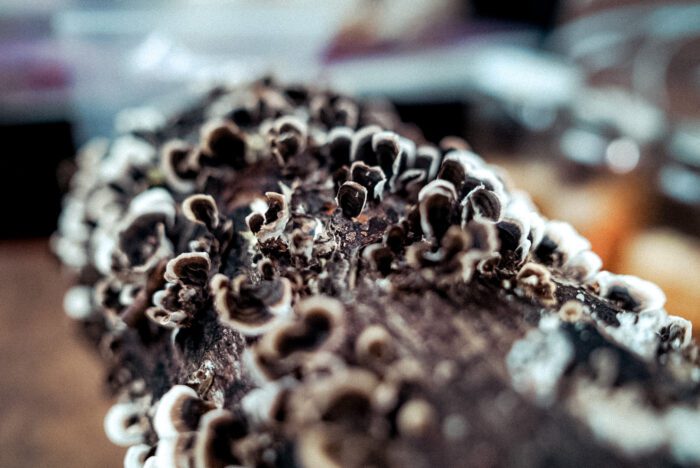
Look for thin, flexible, fan-shaped brackets in overlapping clusters on dead hardwood. The top surface has distinct concentric bands of colour and a slightly fuzzy, velvety feel. The real giveaway is underneath: true turkey tail has a white, pored surface — tiny pores you can see up close.
Its main lookalike, “false turkey tail” (Stereum species), has a smooth underside with no pores. That pored-versus-smooth check is the quickest way to tell them apart. As always with foraging: if you’re not sure, don’t use it.
Free Beginner’s Guide
Grow your first mushrooms — for free
Get the free guide that walks new growers through the whole path — plus 5 free videos to send you on your way.
- The exact gear you need — and the pricey stuff you don’t
- Where to source spores & cultures without getting scammed
- How to spot and beat contamination before it wipes out your grow
Where it grows
More or less everywhere there’s dead hardwood — logs, stumps, fallen branches — across most of the world. It fruits in overlapping shelves and is around for much of the year. Once your eye is tuned to it, you’ll see it constantly.
Why people use turkey tail
Turkey tail is best known as an immune-supporting mushroom, and it’s one of the most researched of all the medicinals — its polysaccharide compounds, PSK and PSP, have been studied extensively, particularly in Japan and China. It’s a cornerstone of the medicinal mushroom world for good reason. (We share this for education — it’s not medical advice, and turkey tail isn’t a treatment for any condition.)
How to use turkey tail
Here’s the key thing: you don’t eat turkey tail. The fruiting body is thin and leathery — there’s no chewing it. Instead you extract it. The two traditional ways are a long-simmered tea (a decoction) and a double-extracted tincture, which pulls out both the water-soluble and alcohol-soluble compounds. Turkey tail is one of the classic mushrooms for that double extraction method.
Can you grow turkey tail?
You can. Turkey tail is a wood-lover, so it’s cultivated on supplemented hardwood sawdust or on inoculated hardwood logs — the same broad approach used for shiitake and other wood-loving species. It’s a satisfying one to grow because it’s so willing.
Foraging and sustainability
Turkey tail is abundant and grows on dead wood, so a careful harvest does no harm to a living tree — take a few brackets, leave plenty, and let the fungus keep doing its decomposition work. Only ever harvest what you can confidently identify.
Frequently asked questions
Can you eat turkey tail mushroom?
Not as food — it’s far too tough. It’s used as a tea or a tincture, never chewed.
How do you tell turkey tail from false turkey tail?
Check the underside. True turkey tail has a white, pored surface; false turkey tail is smooth underneath.
What is turkey tail used for?
It’s best known as an immune-supporting medicinal mushroom and is among the most researched of all the medicinals.
Is turkey tail easy to grow?
Yes — as a wood-lover it grows readily on supplemented hardwood sawdust or inoculated logs.
Keep exploring
Turkey tail is one of the great medicinal mushrooms — alongside reishi and lion’s mane. If you’d like to make your own medicine from it, our guide to making a mushroom tincture walks through the double extraction step by step, and the Online Mushroom Cultivation Course covers growing medicinal mushrooms at home.
This article is for educational purposes and is not medical advice. These statements have not been evaluated by the FDA. Mushroom products are not intended to diagnose, treat, cure, or prevent any disease. Consult a healthcare professional before use.