


Mushroom Contamination:
How to Spot and What to Do
The three most common types of mushroom contamination are trichoderma (blue-green mold), bacteria (slimy wet patches, sour smell), and cobweb mold (gray, wispy, fast-spreading). If you see trichoderma, remove the contaminated container immediately. Bacteria and cobweb mold can sometimes be salvaged with hydrogen peroxide and better airflow.
In the world of mushroom cultivation, contamination is as inevitable as death and taxes. That’s why a solid understanding and consistent practice of the fundamentals of sterile technique is so important.
Yet even with a flawless workflow, contamination will at some point find its way into your grow bag, grain jar, Petri dish, or monotub. All that’s needed is a nutrified substrate, a weak mycelial culture, and a chance. When that moment arrives, you want to know how to spot mushroom contamination, and just as importantly, what to do about it.
Mushroom Contamination #1: Trichoderma
E.g. Trichoderma spp.
Trichoderma is a genus of green mold that preys on other fungal mycelium and is easily distinguished by its vibrant blue-green color during sporulation. Of all the types of contamination you may encounter, trichoderma is one of the easiest to identify—especially after sporulation—and one of the most difficult to contain. Trichoderma harzianum is the most common and is known to produce an aggressive white mycelium that causes a soft decay in mushrooms before it sporulates into a vibrant green.
HOW TO SPOT
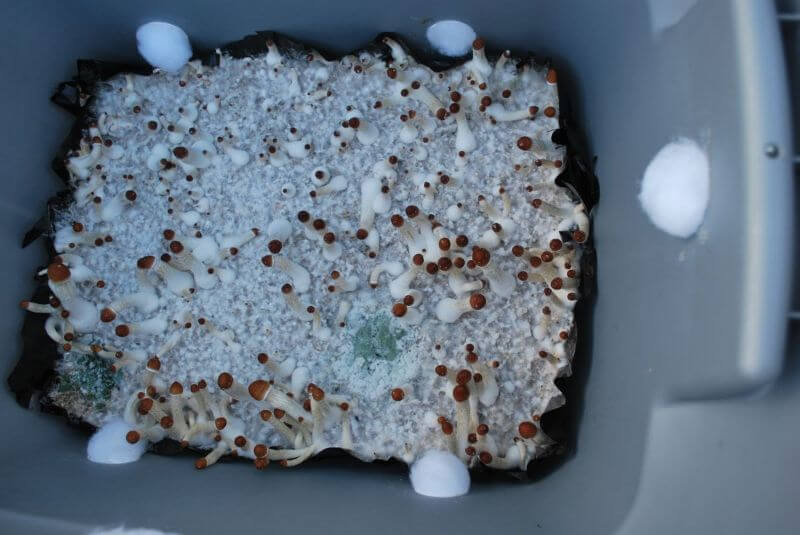
Trying to identify and eradicate trichoderma when it is in the stage of growth right before sporulation is difficult yet vital to save your crop. At this point in its life cycle, it can appear similar to mycelium. In the photo below, note the thick, fluffy appearance on trichoderma rising from the substrate. Mycelium does not look like this. Instead, mycelium appears more rope-like and stays tight to the substrate.
Once trichoderma sporulates, though, it’s practically impossible to misidentify. In the photo below, note the green splotches characteristic of trichoderma.
WHAT TO DO
Trichoderma is notorious for being practically impossible to contain once it takes hold. If it starts to sporulate, your best bet is to get the trichoderma-contaminated petri dish, grain jar, grow bag, or monotub as far away from your lab and/or fruiting room as quickly as possible. If you don’t, you risk it spreading and your mushroom contamination issue turning into a full fledged crisis as it contaminates neighboring dishes, jars, bags, and tubs.
Nonetheless, if you’re hell bent on trying to save whatever it is that’s contaminated, spreading salt on the affected area is one approach used in Agaricus mushroom production farms when encountering trichoderma. We don’t recommend this approach unless it’s, say, your only tub. We think simply cutting your losses and ditching the trich’ train altogether is a better idea.
After you spot, identify, and rid yourself of trichoderma, it is a good idea to sanitize everything in the affected area as much as possible before beginning another grow. It’s also smart to look back at your processes to attempt at identifying where the mushroom contamination issue likely began (more on that later).
Not sure what you’re looking at? Ask someone who has seen it a thousand times.
Most photos tagged “contamination” in our community turn out to be healthy mycelium. The rest we help you catch early. Post a photo in the Mushroom Membership and a grower who has been where you are tells you what it is and what to do next.
Rather prevent it for good? The Online Cultivation Course covers sterile technique from day one.

Mushroom Contamination #2: BACTERIA
E.g. Bacillus spp.
When it comes to bacterial mushroom contamination, the most common type is Bacillus spp., also known as “wet spot” or “sour rot.” Mushroom cultivators typically soak their grains for 12 to 24 hours before hydrating or sterilizing them.
Why? Because bacterial endospores can be heat resistant, meaning they’ll survive the pressure cooking process. By soaking the grains overnight, we circumvent this issue. In essence, soaking the grains causes any bacterial endospores on the grains to awake and germinate. Then, once the grains reach sterilization temperatures during the pressure cooking process, those pesky heat resistant endospores die off. Without the soak, the endospores could lay dormant and survive the sterilization process, coming to life after you’ve already inoculated your grains and ruining your grow.
HOW TO SPOT
As for its appearance on petri dishes, bacterial contamination looks like a slimy, wet patch, hence the nickname “wet spot.” In grains, bacterial contamination appears dull gray, slimy, excessively wet, similar in appearance to mucus, and is easy to identify by taking a big ‘ole whiff of your grain jar when you suspect it is present. As the nickname “sour rot” suggests, if your grains smell sour, you’re probably dealing with Bacillus spp.
WHAT TO DO
The best way to avoid bacterial mushroom contamination like Bacillus spp. is to soak your grains for 12 to 24 hours at room temperature before you begin the sterilization process. In this way, the heat resistant endospores, if viable, will germinate and then be susceptible to the standard sterilization process.
If you encounter bacteria on a petri dish, it can be a fun experiment to let it sit for a few days to see how your mycelium culture responds. If bacterial mushroom contamination is encountered on grain, it is possible to separate the bacterially contaminated grains from the rest of the healthy myceliated grains, but this usually only works if the bacterial patch is small and contained to one area.
Mushroom Contamination #3: COBWEB MOLD
e.g. Hypomyces spp.
Cobweb mold is not one species of mold but rather a closely related group of mold species that tend to cause soft rot in mushrooms. Usually, one encounters cobweb mold in grain spawn and monotubs. Not sure if what you’re seeing is cobweb mold or healthy mycelium? Check out our deep-dive: Cobweb Mold vs Mycelium — How to Tell the Difference.
HOW TO SPOT
Cobweb mold can be difficult to spot because it appears grey, white, and fluffy, similar to mycelium. Typically, it grows three-dimensionally, levitating above the substrate in wispy, white tufts. Cobweb mold spreads fast, causes your baby mushrooms to abort their growth, and in some cases can prevent your mushrooms from growing at all.
To identify cobweb mold, you must learn how to distinguish it from mycelium. Cobweb mold is usually greyer and more wispy than typical mycelium. It possesses very fine strands when compared to the rope-like hyphal growth of mycelium, and has the smell of mildew.

WHAT TO DO
If spotted early, you can control cobweb mold and salvage your grow using hydrogen peroxide. Hydrogen peroxide (H2O2) spray is a great weapon in the battle against mold because it will not harm your mycelium but will kill any mold and/or spores trying to take over your monotub. To limit the chances of encountering cobweb mold, make sure your grains/substrate aren’t overhydrated since cobweb mold prefers high humidity and stagnant air.
Where You Went Wrong
The most common cause of mushroom contamination is incorrect sterilization. Poor sterile workflow is another common cause, as is working with weak mycelial cultures or trying to cut corners with your preparation.
If you practice good sterile technique, make sure you properly prepare and sterilize your substrates, and ensure you’re as clean as you can be before working with sterile substrates, you’ll definitely increase your chance at success. And if you find yourself overjoyed with the process and ever thirsty for more, you may have just found your calling at the perfect time.
To learn more check out our video on “How to Spot Contamination in your Agar, Grains and Liquid Culture”
Frequently asked questions
Healthy mycelium is bright white, dense, and rope-like, and smells faintly mushroomy or like fresh earth. Contamination shows up as color where it shouldn’t be: blue-green, grey, black, or pink. Slimy wet patches and a sour or musty smell are red flags too. When in doubt, trust your nose.
Almost certainly trichoderma, the most common contaminant in cultivation. It starts as white fluffy growth that looks a bit like mycelium, then turns vivid blue-green once it sporulates. By the time it’s green it’s already throwing spores, so get it away from your grow space fast. Trichoderma is brutal to contain.
It depends on the culprit. Trichoderma is nearly impossible to stop once it takes hold, so the move is to remove that container right away. Bacteria and cobweb mold caught early can sometimes be salvaged with hydrogen peroxide and better airflow. When a grow is far gone, cut your losses to protect the rest.
Cobweb mold is grey, wispy, and grows in loose three-dimensional tufts that float above the substrate, and it spreads fast. Healthy mycelium is whiter, denser, and clings tight to the surface in rope-like strands. Cobweb also smells like mildew. Caught early, a hydrogen peroxide spray can knock it back.
Usually incorrect sterilization or a sloppy sterile workflow. Weak mycelial cultures and cutting corners on prep are common culprits too. Spores and bacteria are floating around constantly. You’re not aiming for a perfect clean room, just for stacking the odds so your mycelium colonizes before anything else gets a foothold.
Tighten your sterile technique. Sterilize your substrates properly, soak grains before pressure cooking to kill heat-resistant bacteria, work clean and calm, and start with strong healthy cultures. A still air box is the single biggest upgrade for keeping contaminants out. Our cultivation course walks through the whole sterile workflow step by step.
Keep Learning & Growing
Contamination is part of the journey — every experienced cultivator has lost a few grows to trich or bacteria. The key is building better systems. Here are the best next steps:
- Cobweb Mold vs Mycelium — still not sure what you’re looking at? Our detailed photo guide will settle it.
- How to Make a Still Air Box — the #1 way to prevent contamination from entering your grow in the first place. Build one in 10 minutes for under $20.
- Best Still Air Boxes for Mycologists — prefer to buy one? We reviewed the top options.
- 5 Common Mushroom Cultivation Mistakes — contamination usually starts earlier than you think.
Ready to take your cultivation seriously? Our Online Mushroom Cultivation Course covers sterile technique, contamination prevention, and every step from spore to harvest — with 70+ video lessons and a 130-page workbook. Or if you want to go deeper with a community of serious growers, the Mushroom Mastermind is where the real transformation happens.






56 Responses
I really enjoyed that, very informative thank you! And Just like So Many Before me that also felt very confident and quiet educated, to now JUST learning about about contam on my cakes! 🥴 I was aware and prepared for the innoculations and sterile sterile sterile, unfortunately that was as far as I got On that, I was led to believe once the mycelium covered the substrate we were home free baby!! 🥳 and yeah, not the case I only knew to look up info about contaminated cakes after it was already to late. What a bummer Cuz I looked All over you tube for a COMPLETE start to finish everything happens could happen, best ways, best spores, things I’d need And what bullshit to stay away from rip offs expensive Martha tents ECT ECT so yeah, I would have loved to known that’s all I’m saying, damn 🤫🤗✌️
Contamination, like s#it, happens. It happens to everyone. Identifying where you went wrong and tightening up your sterile technique is all you can do. Reading this article I learned something new. I have always been told to cook, not soak, my grains. Now I have sour mold in my some of my grain jars for the first time. So even though I am grower going into my 3rd year, I am still learning new things all the time.
I have a monotub that is displaying gray and white mycelium I’m concerned it’s contaminated. I don’t smell sour or gym sock just kind of musky
Might be cobweb mold
I am a new button mushroom grower.I have ran into a problem and I hope someone might help me on here.My mushroom trays have been contaminated by cobweb and I can’t seem to get it under control.I am still at spawning stage and my trays are covered by newspapers.My question is..besides hydrogen peroxide,what else can I use which wont kill of mycelium?
Look out for the Grey it a sign of contamination also It should smell like earth not musky
Some of the DNAs produce very suspicious stuff on the top – especially if you are using casing layer (I do vermiculite for some of my spawns) – but just let it sit for a day or two and typically it ends all fine – all the contam failures typically hitted me during innoculation and early mycelium growth, I never experienced contam in my cakes – just follow the 101 for best practices and dont overcomplicate your stuff.
Does your mescaline look a little brown when In fruiting chamber.
Does your mescaline look a little brown when In fruiting chamber.
it’s called mycelium
a cactus?
The surface of my growkit mycelium is turning slightly yellow and brown in 1 corner. I first noticed it today: It’s in the stage where the first mushroom heads have started popping up above the surface 3 days ago. The discoloration is faint, but it’s definitely yellowing/browning somewhat.
What could this be and what can I do to prevent it’s spread?
Mycelium pee. Just drain poke a hole let drain put medical tape on it or micropore
They don’t “pee”. This is a common misconception. They’re releasing antibiotics to fight containments .
This is my 1st time growing and my mushrooms begin to grow a black mold on top of them them is there any way to salvage average any of the trays?
So if it showed up, black stuff on the mushroom caps…seemingly over night, it’s most likely spores that the mushrooms released, I like to harvest them right before the veil under the cap breaks. Cuz all those black spores just aren’t too pretty. However they are harmless.
I have a contaminated bag of rye spawn that I inoculated with spores. It looks wet and green now. I bought the spawn bag pre-made.
I realize it’s done for.
But I’m curious- instead of simply chucking it in the trash- what about opening the bag and pouring the contents somewhere to see what happens? I live in a rural area where I can dump it outside at the base of a tree in shade. It’s very hot these days so I’m not sure how that’ll go. But what do you think?
Could nature surprise us?
I can tell you for a fact 4 times over from dumping tubs in my flower beds and one in the woods, it can and probably will fruit. I dumped 4 over the summer due to contam. I live in Texas. The weather was very hot and dry (over 100 degrees Fahrenheit ). Obviously nothing happened for a while, but about 6 weeks later, we got a good rain and poof…there they were…4 different spots…fruiting like crazy.
Why does my mycelium have a purple tint in places?
That’s from harvesting a touch late- spores dropped onto the mycelium. That’s if it has already produced a flush.
Hi, my B+ started to develop a big white elongated head on the top. Not one but all of them. Currently, I am growing 2 monotub and only one tub has this. It seems like there is no contamination but I am worried.
I wish I could put on a picture to show. Do you know what this is?
My B+ has started to develop a white elongated thing on the top. Not one but all of them. I have two monotub and the only one tub has this thing. My impression is not contamination but I am worried. Any idea?
I have something in one corner of my substrate that looks similar to the cobweb mold but it is coral colored and looks almost like dust in some parts. Has anyone else experienced this. The tub does not smell moldy so I am confused.
I have a white film around the lower perimeter of my tub. The spawn otherwise looks super healthy and I’m pretty much ready to move to fruiting. I scraped of a bit of the film which is looks similar to rolling paper but thicker. The film itself smells strongly of mushroom, earthy. Not nasty, sour etc. Should I be worried?
Very helpful. Pictures with an explanation to go with the knowledge. Thanks for sharing.
First grow and need help to know if they look okay…B+ strain. Can anyone help?
I am displaying white? Growth. Definitely smells like wet gym socks. What percent H2O2 should I spray?
I need help I’m pretty sure I have contamination my friend bought these in a bag kit and they look horrible he spent a lot of money on them so I wanted to try and save them but now after reading this I’m not so sure ;( is it worth trying if so how would I considering they are in a bag with dirt and all ?? Please help
If I got green in with the mycelium after 1wk would it most likely be a bad bag.. no soak before autoclave…? or a bad syringe?
Could be either contaminated spores or contaminated grain that wasn’t properly prepped. Try working with some agar Petri dishes to too if the spores are contaminated to rule that part out at least.
I have blue mold growing on the surface of my grow bag of Lion’s Mane in the kitchen.
What is it and what did I do wrong?
Thanks alot for the helpful info, I am waiting for my mycelium to start and I think this will help ,but any more tips, would be greatly appreciated. I have a mini boomer mushroom kit ,by monster mushroom
Help. I’m getting stunted mushrooms and I have no idea what’s going on. I’ve been successful prior and no changes… airflow, moisture all good. But mushrooms are capping at 0.5cm. What am I doing wrong?
Probably genetics, try propogating more on agar
So my Mycelium did well in the all in one bags and even better once I transferred to the mono tub. When I looked last night after work their is a light tan coloring going on. Any ideas as to what it is other than the light tint the tub looks completely colonized with a light moisture layer. These are blue angels or flying saucers. Don’t know if that matters.
Hi there academy folks,
Thank you for this excellent article. I’d love to send you a photo. I was under the impression that I had cobweb mold and almost abandoned my grow bags. I put them in my fruiting chamber and there is successful growth. I’m still curious if some of it is cobweb or that’s all mycelium.
Thanks-Mark
We have been encountering mold contamination on our last 3 batches of growing. We were injecting a grain bag, letting the mycelium grow, then transferring it to a grow box. We thought it was our transfer process (box not sterilized, foreign contaminants, etc). On our most recent grow we tried a all-in-1 grow bag. We injected and left it to cultivate. In 1 of the 5 grow bags, we once again had mold take over. We sterilized the needled, and it really was not subjected to any foreign contamination that we can think of. Could it be where we are leaving the bags to sit and grow? Could it be a humidity/temp issue? Could it be mold in the air getting inside the bag and contaminating? I suspect I have a mold issue in my house due to some leaking faucets in the past. Could that be a cause? Could it be a quality issue from the supplier? Any insight is appreciated. I also have pictures of the infected grow bag: thanks in advance!!
Thank you.
For the Hydrogen peroxide application, is the standard, drugstore concentration of 3 percent okay or should it be further diluted with tap or DI water?
Should be good enough yea 🙂
So I have them ” fruiting” in a magic bag. There was light orange liquid, and I read about the metabolite response. I poured out 2/3 of the liquid into a jar. No foul smell. I left some so it could do its protective work. I can see good thongs happening, but its been slow. My apt temp is usually like 66 or 67. I had them in the closet for like 6 weeks, then I’ve had them in the light by my bedroom window with no direct light. I’m worried as time goes it will turn sour. I’m a first timer.
Your grows are amazing. You can see the passion in your eyes. One love. Thank you for your knowledge and education.
Very informative. Tks
Is it true that the owner of Cultural Mushrooms a fraud? I heard his grow bags are bogus and instead of a syringe of a mycelium to inject in the bag to grow happy mushroom is in fact just water.
If I have “Mushroom Contamination #2: Bacteria, e.g. Bacillus spp.” and am using an all-in-one bag that will be ready for fruiting, will it be safe to harvest after fruiting? Should this bacteria not be eaten?
Any experience with a pink colour on mycelium already fruiting? Started as light pink then darker pink spots? Salvaged the mushroom outside of the affected areas and dried them. Do you think they are safe to eat?
Information was very helpful… Would like to do some online courses
Fantastic! Our sale is still going strong for another couple of hours 🙂 https://fungiacademy.com/magic-mushroom-cultivation-course/
Well I’ve been unsuccessful mostly in any large yields, Trichoderma seems to be my nemesis. I should note I and now working in a hand box and sterilizing everything and anything that goes near that box. I am using a inkbird for humidycontrol, is distilled h20 a must, or not at all? The ink bird is a great practical tool but I feel like it opens up a whole new area or entrance point for contamination. Would you recommend this product? I’m getting my grain spawn and any bulk from professional sources claiming all ingredients are fully sterilized. I almost hate to bother you with such a beginners question but I just can’t get around this one fungus. Just one more question I promise, is H2O2 a real solution? Thanks for any input
What do I dilute my peroxide to or just put it in the spray bottle full strength?
Hi. Thank you for this great info.
I’m growing in a grow back, and the shrooms have just started pinning. However, there is also some spreading trichoderma. At present, it’s not touching the pins themselves. Am I still ok to harvest the crop?
yes for sure! As long as its not touching
Thanks Sam,
I am just starting to cultivate my own mushrooms for personal use. I am 3 weeks in and my mycelium is coming along nicely (I think). My spores were Golden Teacher
Your video was very informative.
Regards George . All the way from New Zealand
Explained well and the pictures were great.
With all the bad advice out there, this was a breath of fresh air.
I’m so grateful for your information and beautiful layout! Much love <333
Thank you thank you!